


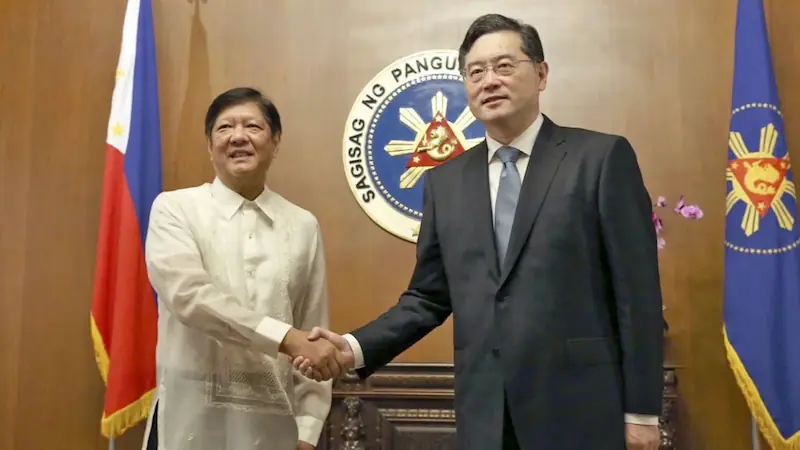


The Philippines, situated between China and the United States, has had to strike a delicate balance in dealing with the two superpowers' competing interests, a complex juggling act that has been on vivid display in recent weeks. The country hosted large-scale joint military drills with the US while also receiving a top envoy from China, which has grown increasingly rattled about the archipelago's defense ties. Last year, the election of President Ferdinand Marcos Jr. returned relations to a more even keel, in part because Manila has become wary of a more assertive China. Marcos Jr., who is on a charm offensive to mend ties with Manila's historical ally, is set to fly to the United States to meet with President Joe Biden in Washington next week.
More than 12,000 American troops joined some 5,000 soldiers from the Philippines over the last three weeks to take part in the largest "Balikatan" joint military exercises to date, an event Beijing's state-run media has labeled an "attempt to target China." The climax of the war games came when US and Philippine forces fired on a mock enemy warship in the West Philippine Sea, the part of the South China Sea that encompasses the Philippines Exclusive Economic Zone. Just as those drills kicked off, the US also hosted two top diplomats from the Philippines for talks during which both sides agreed to complete a roadmap for the US to provide security assistance to its regional ally in the next five to 10 years.
Last February, the Philippines granted new rights to the US military to add four bases to the five originally covered under the Enhanced Defense Cooperation Agreement (EDCA). The new facilities include three on the main island of Luzon, close to Taiwan, and one in Palawan province in the South China Sea, which appears to have alarmed China. Earlier this month, Beijing's ambassador in Manila accused the Philippines of "stoking the fire" of regional tensions by offering expanded military base access to the US, saying that the goal was to interfere in China's affairs with Taiwan.
The Philippines has responded that it has no intention of interfering in the Taiwan issue and that the EDCA sites were not meant for offensive operations against China or for interference in the Taiwan issue. With tensions high over the Beijing ambassador's comments, Chinese Foreign Minister Qin Gang arrived last Friday for a three-day visit to Manila, where he met with Marcos Jr. and Foreign Secretary Enrique Manalo. The readouts suggested both sides were keen to calm the waters, with Marcos Jr. announcing "more lines of communications" to resolve conflicts between the two countries over the West Philippine Sea and Manalo also pledging to "overcome difficulties and interference."
Analysts say the positioning of the Philippines makes the archipelago vital for anyone wanting to project power across the Pacific. "The Philippines is crucial in safeguarding the national security interests of both China, as well as the security or strategic interests of the United States in the Pacific," said Aries Arugay, a visiting fellow at Singapore's ISEAS-Yusof Ishak Institute. "And this is why both superpowers are very sensitive every time the Philippines is being perceived as leaning more towards one or the other," he added.
As the US-China rivalry intensifies the Indo-Pacific, their competition for influence has been localized within the Philippines, particularly in the provinces where American bases are located. There were pockets of protest in Cagayan province, the northern mountainous region where three out of the four new EDCA sites are to be built. At least 5,000 people in Cagayan held demonstrations and prayer rallies, as they believed that America's self-interest was prioritized before the native residents, according to the Cagayan Provincial Information Office.