


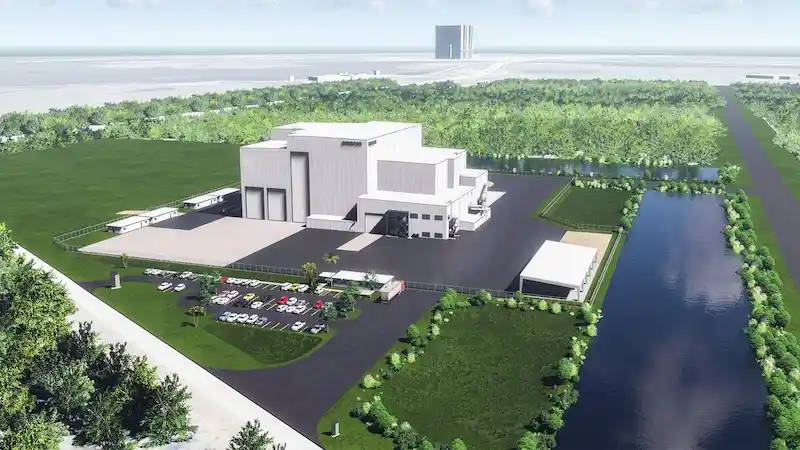


Amazon.com Inc. has revealed its plans to construct a state-of-the-art satellite-processing facility in Florida, with a projected cost of $120 million. This facility will play a crucial role in supporting Project Kuiper, an ambitious initiative aimed at providing internet access from outer space.
Located at NASA's Kennedy Space Center, the facility is strategically positioned next to key launch sites, making it an ideal location for preparing Kuiper satellites before they are sent into orbit. Project Kuiper is comparable to SpaceX's Starlink, as both projects aim to utilize thousands of satellites in low orbit to deliver broadband internet connectivity to every corner of the globe. Amazon intends to launch an impressive fleet of 3,236 satellites, ultimately forming a reliable network that can bring online connectivity to hard-to-reach areas worldwide.
Steve Metayer, the Vice President of Productions and Operations for Kuiper at Amazon, emphasized the need for an efficient payload-processing facility due to the scale and frequency of satellite launches required for the ambitious project. Metayer stated, "When we realized the scale of our constellation and the launch rate we have to have, it was pretty apparent to us that we had to have a significantly effective and efficient payload-processing facility."
While Amazon has not specified the exact number of customers it hopes to reach through Project Kuiper, CEO Andy Jassy highlighted the immense potential of the initiative, stating in April that it "has the chance to be a very large business." Jassy also emphasized that there are still hundreds of millions of people worldwide who remain unconnected to the internet.
Although the regular launch schedule for Kuiper satellites has not been confirmed, Amazon has secured partnerships with several reputable rocket providers. In April 2022, Amazon signed agreements with Blue Origin, Arianespace, and the United Launch Alliance (ULA) to conduct as many as 83 launches. ULA's Vulcan rocket is expected to handle the majority of launches, while Blue Origin's New Glenn and Arianespace's Ariane 6 will also contribute. In a separate deal, Amazon contracted ULA's Atlas V, which is currently operational, for nine Kuiper launches.
In order to comply with its license with the Federal Communications Commission (FCC), Amazon must launch half of its Kuiper satellite constellation by 2026. The company anticipates completing the processing facility by 2024 and commencing operations there in 2025. Metayer expressed confidence in the project's progress, stating, "I'm obviously very confident in our own technology, our own satellites. And we're also very confident that the partners we have – the progress they're making on their launch vehicles, too."
The newly manufactured Kuiper satellites will be transported from Amazon's plant in Kirkland, Washington to the Florida facility for inspection and preparation. Here, the satellites will undergo rigorous checking before being placed in the payload fairing (or nose cone) of the rockets. As Arianespace's Ariane 6 is anticipated to launch from French Guiana, Amazon's processing facility will primarily focus on preparations for New Glenn and Vulcan launches.
While ULA and Blue Origin will have their own processing facilities, Amazon deemed it necessary to have its own facility to accommodate multiple launches simultaneously. The Florida center is specifically designed to support three rocket launches concurrently and process 120 satellites every month, ensuring scalability and efficiency.
Amazon's plan is to launch two prototype Kuiper spacecraft on Vulcan's long-delayed debut flight later this year. New Glenn is expected to make its inaugural flight in 2024, and while Arianespace's Ariane 6 was initially scheduled to launch by the end of this year, a supplier has indicated a potential delay.