


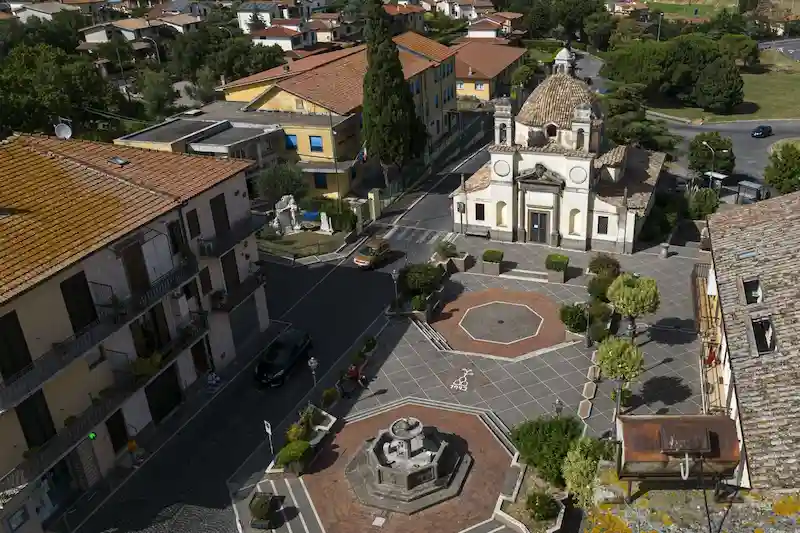


When the small town of Monterosi, located near Rome, sought European Union funding to construct a preschool, it encountered a frustrating and lengthy bureaucratic process. This ordeal sheds light on the challenges that Italy currently faces. Mayor Sandro Giglietti had hoped to tap into the €192 billion ($216 billion) allocated to Italy through the Recovery Fund to support an initiative aimed at attracting families, a crucial policy to boost population growth and female employment.
However, what should have been a straightforward task for a small building project took local officials a staggering 18 months to navigate. They encountered multiple layers of bureaucracy, receiving paperwork requests from both national ministries and the EU. Compounding the issue was an escalating inflation spiral that made cost estimations difficult, leaving contractors hesitant to commit.
This cautionary tale demonstrates the uphill battle that Prime Minister Giorgia Meloni faces as she attempts to distribute the largest aid program since Italy's post-World War II reconstruction across the country's economy, which ranks as the third largest in the eurozone. The fact that a simple local proposal -- one that is fundamental to the country's growth potential by promoting parenthood and addressing low female workforce participation -- almost did not materialize underscores the risk that numerous other projects, including those related to digital transition, hospitals, and green energy, may fail to materialize.
This presents a significant problem for Meloni's right-wing government, whose economic expansion plans rely heavily on the efficient utilization of EU funds. In the case of preschools, it also breaks Meloni's promise to voters that she would support Italians in having more children and provide free childcare throughout the country.
Italy's Minister for EU Affairs, Raffaele Fitto, has already acknowledged that the country may not be able to complete certain projects needed to access EU funds by the 2026 deadline. Currently, Italy is working to renegotiate the terms of the EU Recovery Fund, with Brussels indicating that it may allow some flexibility but on a case-by-case basis.
Eurasia Group senior analyst Federico Santi warns that "financing will increasingly be delayed and withheld by the EU as Italy fails to meet agreed program targets owing mainly to administrative shortfalls and bottlenecks." This poses serious risks to Italy's medium-term economic growth outlook.
In a country plagued by low fertility rates and a shrinking population, Monterosi's struggle to build a preschool is particularly poignant. This is why approximately €4.6 billion in EU funds were made available to local communities to support childcare initiatives. Azzurra Rinaldi, head of the school of gender economics at Rome's Sapienza University and a mother of three, has even started a petition calling for more public preschools, emphasizing that "you need women to work for economic growth and you need more population for economic growth."
Monterosi's main challenge lay in dealing with an unfamiliar and complex application process, which included differing requests from various levels of government. The mayor's advisor, architect Giulia Martoni, advises others embarking on similar projects to arm themselves with patience. Changes in allocated funding and rising costs for construction materials further complicated matters, requiring additional resources and renegotiations with involved companies.
However, poorer towns were unable to overcome these hurdles due to a lack of expertise in navigating the application process. The government is now attempting to address this by providing advisors and training courses. Gianpaolo Nardi, mayor of Castel San Pietro Romano, a small village east of Rome, believes that the government could do more to assist, emphasizing the need to train local administration officials and recounting his own difficulties in accessing funds for re-qualification projects in his area.
The first tender for preschools in late 2021 only allocated €1.2 billion due to a lack of applicants. After Rome encouraged municipalities to submit proposals, additional funds were assigned. However, two more attempts were required to secure the full amount. This process revealed another challenge: towns and villages must have the means to employ staff in the new schools. Smaller municipalities, especially those in the economically disadvantaged south, often lack the necessary funds, which discourages them from applying.
The government's website indicates that approximately 1,800 school projects are planned throughout Italy, with completion scheduled for the end of 2025. Italy has long struggled to efficiently disburse EU funds, and this time was meant to be different. While progress may still be possible in some areas, it will require perseverance and energy from communities that have become accustomed to navigating Italy's sluggish bureaucratic machinery.
Looking back on his own battle against Italy's bureaucracy, Mayor Giglietti reflects on Monterosi's struggle to secure funding for the preschool, stating, "We got the money in the end, so it's feasible. But it was a tough fight - and a close call."