


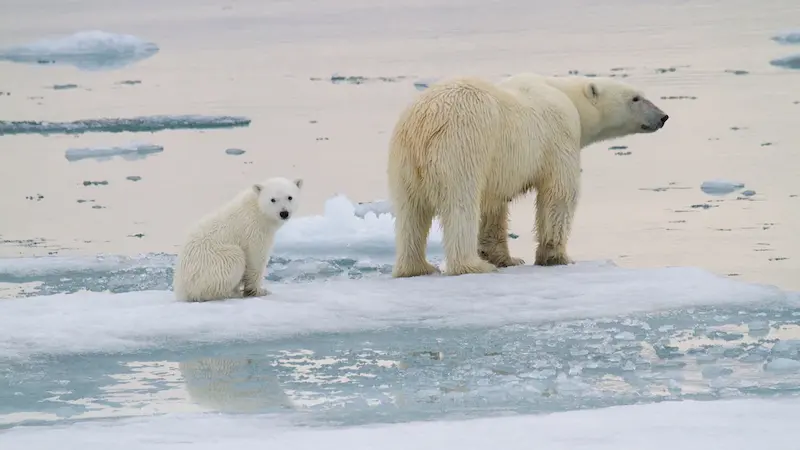


Scientists have made a groundbreaking discovery, establishing a definitive link between human-related greenhouse gas emissions and the reproductive and survival rates of polar bears. This significant finding could potentially pave the way for better protection measures for this iconic species.
Polar bears inhabit 19 populations across the Arctic, spanning countries including Canada, the United States, Russia, Greenland, and Norway, according to the conservation organization Polar Bears International. All of these populations rely on ice sheets to access their main source of prey – two species of seals.
However, human-induced climate change is accelerating the loss of sea ice, leaving polar bears with limited time to hunt and build up their fat reserves. As a result, more and more polar bears are being forced onto land, where they have to survive on the fat stores they accumulated before the ice melted. Consequently, their population is declining at an alarming rate.
To quantify the connection between ice-free days experienced by polar bear populations and greenhouse gas emissions, researchers from Polar Bears International, the University of Washington, and the University of Wyoming conducted a comprehensive study. They examined the number of days that polar bears were deprived of food and compared it with the accumulation of planet-warming pollution released into the atmosphere. Their findings were published in the journal Science.
The study focused on polar bear subpopulations that had experienced at least a decade of ice-free seasons, starting from 1979 when satellite imagery of sea ice became available up until 2020. The researchers discovered that the number of days polar bears endured without food increased as greenhouse gas emissions accumulated.
For instance, in 1979, polar bears in the Chukchi Sea in the Arctic Ocean had to endure approximately 12 days without food. By 2020, this number had skyrocketed to around 137 days. They found that for every 14 gigatons of greenhouse gas emissions released into the atmosphere, an additional day of fasting was added.
Subpopulations located in regions where sea ice typically disappeared entirely during the summer, such as in Hudson Bay, experienced a slower increase in the duration of forced fasting compared to subpopulations in areas where ice sheets would typically remain during the summer, like in the South Beaufort Sea.
The sudden shift in the environment for bears in regions where ice sheets used to persist longer has necessitated a significant adjustment, forcing them to endure fast days that they had previously not experienced. This has resulted in a decline in reproduction and survival rates. A 2020 study led by coauthor Steven Amstrup indicated that the number of ice-free days directly correlates with a decline in polar bear reproduction and survival.
By combining the relationship between forced fasting days and cumulative greenhouse gas emissions with the connection found in the previous study, the researchers were able to estimate the impact of emissions on the rate of polar bear survival.
The implications of their findings are profound. Previously, it was challenging to directly associate emissions with a decline in polar bear populations. However, this study conclusively demonstrates the direct link between greenhouse gas emissions and not only the loss of sea ice but also polar bear survival.
For instance, the study highlights how hundreds of power plants in the US collectively emit nearly 2 gigatons of greenhouse gases each year. Over a polar bear's lifespan of thirty-plus years in the southern Beaufort Sea, this would amount to over 60 gigatons. In this subpopulation, an additional forced fasting day is experienced for every 23 gigatons of emissions, resulting in a 4% reduction in survival rates.
This research sets a precedent for demonstrating the effects of climate change on other species. It establishes a clear connection between carbon emissions and ecosystem impacts, showing that increased carbon dioxide directly affects the survival of polar bear cubs. Consequently, it enables us to link the decline in polar bear populations to specific sources of carbon emissions.
Leading scientist Steven Amstrup hopes that this study will serve as a template for future research, allowing other species affected by human-caused climate change to be protected under the US Endangered Species Act. With a greater understanding of the impact of emissions on vulnerable species, more effective conservation efforts can be implemented to safeguard their future.