


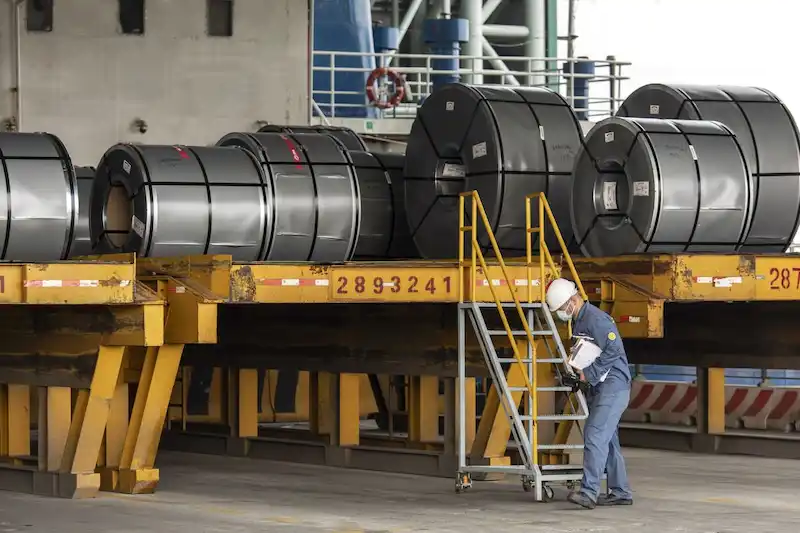


The United States and the European Union are currently engaged in negotiations to reach an agreement that would entail the implementation of new tariffs targeted at excess steel production from China and other countries. This move is aimed at addressing the ongoing issue of non-market practices that have given certain imports from China an unfair advantage. While discussions are still ongoing and the specifics are yet to be finalized, it is expected that the agreement will also provide a framework for other nations to join in the future.
These negotiations are part of the broader Global Arrangement on Sustainable Steel and Aluminum, which has been under discussion between the EU and the Biden administration since 2021. The primary objective of these talks is to settle a trade dispute that originated when former President Donald Trump imposed tariffs on metals imports from Europe on the grounds of national security risks.
Since 2018, the US has imposed a 25% tariff on steel imports, while the EU has implemented similar duties on various steel imports under its own safeguard measures. In an attempt to find a permanent solution to the conflict, the two sides agreed in 2021 to pause punitive measures on each other's goods until October 31 of this year. If a permanent solution is not reached by the deadline, the Trump-era tariffs and EU retaliatory measures will automatically be reinstated on more than $10 billion worth of exports.
However, it is worth noting that the agreement currently being discussed is likely to be an interim one. This means that it may not address all outstanding issues in the overall arrangement, such as the taxation of carbon-intensive imports.
The Office of the US Trade Representative and the European Commission have declined to comment on the ongoing negotiations. However, both sides have expressed their commitment to finding a solution before the deadline, while ensuring compliance with international obligations, including World Trade Organization rules.
Although talks are ongoing, a comprehensive and legally binding deal on the Global Arrangement on Sustainable Steel and Aluminum is unlikely to be finalized this year, as there are still significant differences to be bridged. However, the aim is to reach an agreement on a path forward before a scheduled US-EU summit in late October.
While negotiations continue, existing quota deals targeting European metal imports will remain in effect, despite the European Commission's request for their removal.
If new tariffs are implemented, it would have ramifications for Chinese steelmakers, which have been exporting increased volumes this year due to weak domestic demand. The depreciation of the yuan has made Chinese steel exports more attractive, and any additional tariffs would increase their cost and potentially dampen overseas demand.
China is the largest global producer of steel, accounting for over half of global crude steel production according to the Organisation for Economic Cooperation and Development (OECD).
Reaching a technical agreement on taxing carbon-intensive steel may not be feasible in the short term. As a result, one possible option is for the US and EU to agree on the key principles politically, with the implementation to follow at a later date.
One challenge is that the US currently lacks a methodology to price carbon emissions, and it does not apply any system domestically to regulate emissions from its own firms. This raises concerns for the EU, as any joint action could be seen as arbitrary and in violation of international trade rules, which is a red line for the European side.
The EU already has tools in place to address carbon emissions, including an internal trading system and a carbon border adjustment mechanism that imposes a price on carbon-intensive goods produced outside the bloc.
At present, the US is conducting an investigation into emissions intensity in its steel and aluminum industries, while the EU is seeking to determine which systems used by third countries could be considered equivalent to its own measures. These ongoing processes could potentially lead to greater harmonization between the US and the EU in the longer term, but they will not be completed by the fall.
Additionally, negotiations are underway for a critical minerals agreement between the US and the EU, but they have hit a snag due to various US demands regarding the legal basis of the accords. The conclusion of this minerals deal is vital for European companies to access the benefits introduced by subsidies in President Biden's Inflation Reduction Act.