


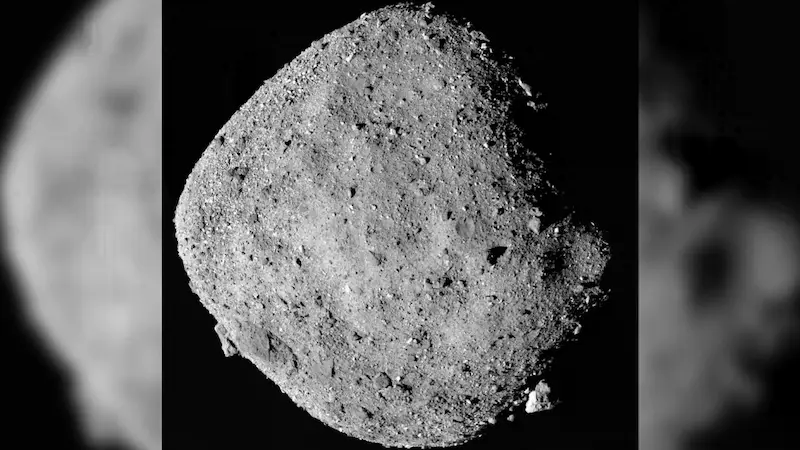


When NASA's OSIRIS-REx spacecraft swings by Earth this Sunday, it will bring with it a precious cosmic gift - a pristine sample collected from the near-Earth asteroid Bennu. The spacecraft is set to release a capsule containing approximately 8.8 ounces of asteroid rocks and soil, which will be aimed towards a landing zone in the Utah desert.
The highly-anticipated moment will be live-streamed by NASA, with the capsule expected to enter Earth's atmosphere at 10:42 a.m. ET, traveling at a speed of around 27,650 miles per hour. Approximately 13 minutes later, it is expected to land safely in Utah.
This sample delivery is a significant milestone in the years-long mission to bring back NASA's first asteroid sample collected in space. The OSIRIS-REx spacecraft, named after its goal to study the origins, spectral interpretation, resource identification, and security of the asteroid, has been on an extraordinary journey over the past seven years. Launched in 2016, it arrived in orbit around Bennu in December 2018.
OSIRIS-REx made history multiple times during its mission. It performed the closest orbit of a planetary body ever achieved by a spacecraft, and Bennu became the smallest object ever orbited by a spacecraft. The spacecraft meticulously surveyed the asteroid, examining its entirety to determine the best location for sample collection.
Bennu proved to be an intriguing celestial body, providing the mission team with unprecedented insights. The spacecraft discovered water ice locked within Bennu's rocks and carbon associated with biology. Additionally, particles from the asteroid were observed releasing into space.
The biggest challenge during the mission arose when the sample collection head on the spacecraft collected an excessive amount of material, preventing proper sealing of the container. However, the team managed to overcome these obstacles and the spacecraft is slated to bring back the largest sample collected by a NASA mission since the Apollo lunar rocks.
After bidding farewell to Bennu in May 2021, OSIRIS-REx embarked on its return journey to Earth, completing two orbits around the sun to align itself for the crucial sample retrieval process. If all goes according to plan, the sample capsule will be released from the spacecraft around 63,000 miles from Earth early on Sunday.
Parachutes will be deployed to slow down the capsule's descent to a gentle landing speed of about 11 miles per hour. A recovery team will be on standby to retrieve the capsule, which will land within a designated area in Utah.
Once the capsule is safely collected, it will be transported to a temporary cleanroom where it will be prepared for further analysis. A team of scientists at NASA's Johnson Space Center in Houston will examine the rocks and soil from Bennu over the next two years. The sample will also be divided and sent to laboratories around the globe, including mission partners at the Canadian Space Agency and the Japanese Aerospace Exploration Agency.
Studying the sample is of utmost importance as it will provide crucial insights into our solar system's origins and the role of asteroids in the development of habitable planets like Earth. Scientists believe that carbonaceous asteroids, such as Bennu, played a significant role in delivering elements like water to Earth during its formation.
Ultimately, this rare cosmic gift has the potential to unlock secrets about the early days of our solar system and shed light on how life on Earth came to be. As Dante Lauretta, the principal investigator of the OSIRIS-REx mission, stated, "We believe that we're bringing back that kind of material, literally maybe representatives of the seeds of life that these asteroids delivered at the beginning of our planet that led to this amazing biosphere, biological evolution, and to us being here today."