


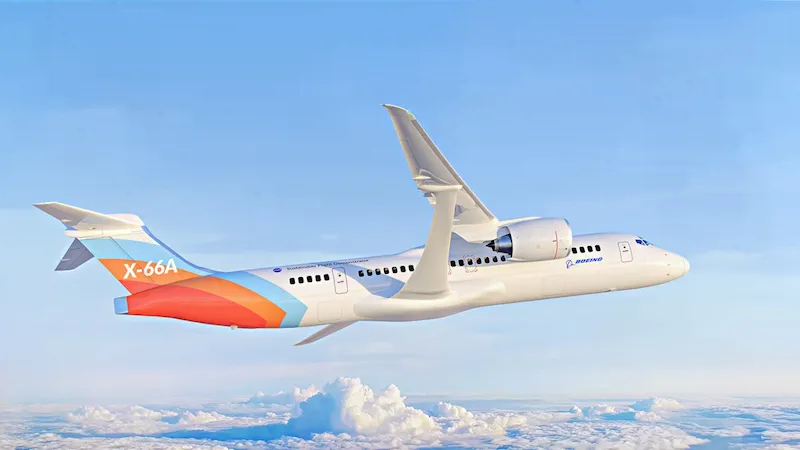


NASA has revealed stunning new liveries for two of its groundbreaking aircraft projects, showcasing their commitment to sustainable flight and aesthetics. One of these projects is the X-66A, a joint effort between NASA and Boeing as part of the Sustainable Flight Demonstrator program. The objective of this project is to develop, test, and fly an emission-reducing, single-aisle aircraft by the end of the decade. The X-66A serves as the full-scale demonstrator for this ambitious endeavor.
Through this innovative partnership, NASA and Boeing aim to create an aircraft design that can potentially reduce fuel consumption and emissions by up to 30% compared to the most fuel-efficient planes available today. They have developed the Transonic Truss-Braced Wing concept, which incorporates elongated, thin wings supported by diagonal struts connecting them to the aircraft. This unique design minimizes drag, thereby minimizing fuel burn.
Unveiled at EAA AirVenture Oshkosh, the X-66A sports a striking livery. The body is predominantly white, with a tail adorned with bold blue, orange, and red stripes. It is important to note that the X-66A is an experimental aircraft, not intended for immediate commercial use. NASA and Boeing are investing in this high-risk technology to validate its potential for future aircraft development.
The first test flight for the X-66A is scheduled for 2028. If successful, NASA anticipates that this technology can eventually serve around 50% of the commercial market for short- to medium-haul single-aisle aircraft. This is crucial as single-aisle aircraft account for nearly half of aviation emissions worldwide, and the demand for such planes is projected to increase significantly in the coming years.
In addition to the X-66A, NASA is also focusing on the development of hybrid electric aircraft through the Electrified Powertrain Flight Demonstration (EPFD) project. Partnering with GE Aerospace and magniX, NASA's goal is to pave the way for a new generation of electric-powered aircraft. This involves collaborating on lighter and more efficient motors, electronics, and materials to enhance fuel efficiency and reduce emissions.
To test these technologies, modified existing aircraft will be utilized. GE Aerospace will conduct ground and test flights using a revamped Saab 340B, featuring a sleek white and blue livery. This aircraft will showcase a megawatt-class hybrid electric powertrain. MagniX, in partnership with AeroTEC and Air Tindi, will test their hybrid powertrain on a modified DeHavilland "Dash 7" aircraft, distinguished by its red and white livery.
NASA plans to conduct at least two flight demonstrations within the next five years to commercialize these cutting-edge technologies in the United States by 2030-2035. The ultimate aim is to benefit short-haul turboprop aircraft as well as regional and single-aisle commercial airliners, revolutionizing air travel and significantly reducing its environmental impact.