


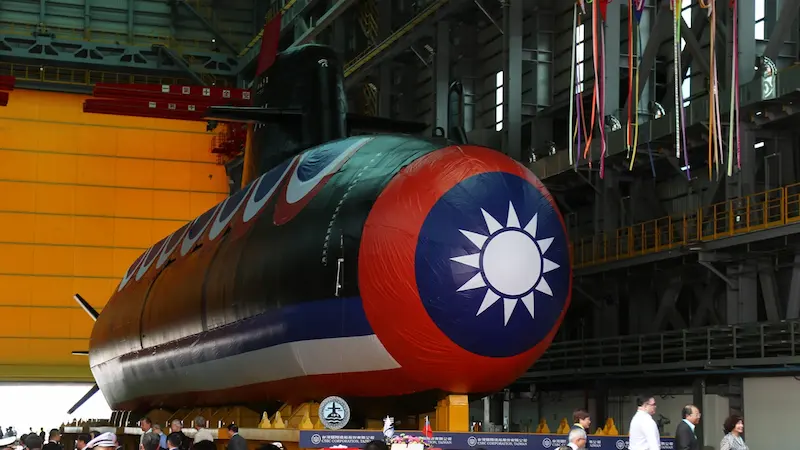


Taiwan achieved a significant milestone on Thursday as it unveiled its first-ever domestically built submarine, a development hailed by the island's president, Tsai Ing-wen. Named "Narwhal" in English and "Hai Kun" in Mandarin, which loosely translates to "sea monster," the diesel-electric vessel represents a concrete commitment to defending the country and serves as vital equipment in the development of Taiwan's naval forces for asymmetric warfare strategies.
The ceremony took place at the submarine's shipyard in Kaohsiung city, where journalists were given a tour but not permitted to take close-up photos for security reasons. Details regarding the submarine's size and capabilities were not disclosed at the event. The ceremony was attended by international dignitaries, including the representative from the US embassy in Taiwan and representatives from the Japanese and South Korean missions in Taipei.
President Tsai emphasized that the indigenous submarine project has been a top priority for her administration. With the addition of the "Narwhal," Taiwan's submarine fleet will increase to three by 2025. Currently, the island operates two Dutch-made submarines commissioned in the 1980s. Taiwan aims to construct a total of eight domestically built submarines.
The strategic significance of the new submarine fleet lies in its role in preventing a Chinese naval blockade of Taiwan. Though the Taiwan Strait may be too shallow for submarine operations, these vessels can prove highly effective in targeting Chinese warships in the Bashi Channel, which separates Taiwan from the Philippines, as well as the waters between Taiwan and Japan's westernmost islands. By deploying submarines in these areas, Taiwan can effectively limit China's military power projection.
According to Admiral Huang Shu-kuang, an adviser to Taiwan's National Security Council and a leader of the indigenous submarine project, the new fleet can enhance Taiwan's second-strike capability. It can effectively restrict China's naval forces within the first island chain, including Japan, Taiwan, and the Philippines, making it difficult for them to access the wider ocean and limiting their ability to intervene in potential conflicts.
The submarines are designed to carry US-made MK-48 torpedoes, enabling them to target surface ships effectively. Taiwan's pursuit of defense self-sufficiency through indigenous military procurement has become increasingly important due to escalating tensions with Beijing. The success of the submarine project serves as a testament to Taiwan's commitment to modernizing its armed forces and reducing its reliance on foreign procurement.
China's claims over Taiwan have intensified during Xi Jinping's leadership. The Communist Party of China views Taiwan as part of its territory, even though it has never controlled it. With Chinese military aircraft conducting numerous sorties around Taiwan and warships crossing the unofficial median line in the Taiwan Strait more frequently, Taiwan's military preparedness has become crucial in the face of potential aggression.
The journey to building Taiwan's first submarine has been challenging, primarily due to budget constraints, delays caused by a global chip shortage, and concerns regarding Chinese espionage. The project commenced in 2016 under President Tsai's administration, following earlier attempts by former president Lee Teng-hui in 1995. Admiral Huang was given a budget of $1.54 billion to build the first ship, with a significant portion spent on acquiring overseas materials and military equipment. He expects the reliance on overseas resources to decrease as Taiwan's domestic submarine shipbuilding industry matures.
Following its unveiling, the submarine will undergo sea trials next month before being commissioned into service next year.