


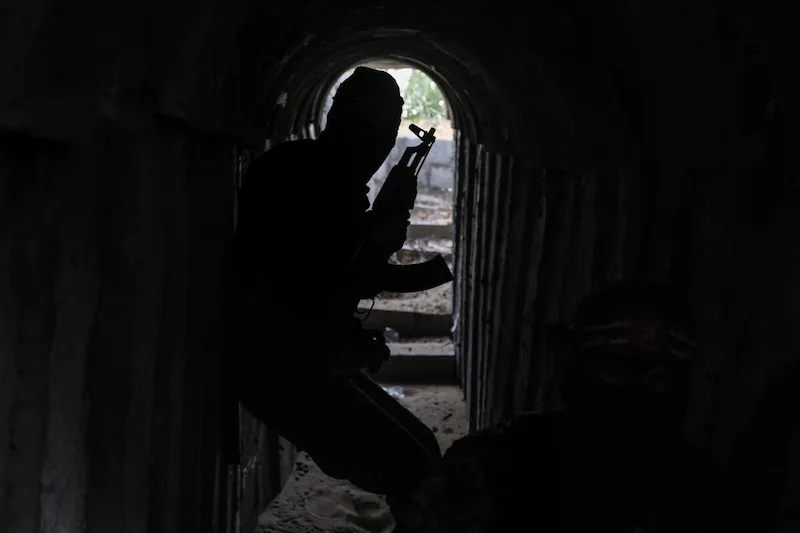


Amidst the ongoing conflict between Israel and Hamas, a unique challenge confronts the Israeli Defense Forces (IDF): the vast network of secret subterranean tunnels built by Hamas. While the Israeli army may far surpass Hamas in technological capabilities, these tunnels have served as a significant asset for the militant group. In response, Israel has invested billions of dollars in developing an underground barrier and a tunnel-detection system to make its territory impregnable. However, these defenses have not proven foolproof, and the intricate maze of tunnels is now complicating Israel's military retaliation.
The underground tunnel network in Gaza is a layered system, with one layer for civilians and another layer exclusively utilized by Hamas. The IDF's aim is to penetrate this second layer, which Hamas has meticulously constructed. However, targeting this underground maze is a formidable task as the full extent of the tunnels is known only to Hamas. Israel claimed to have destroyed 100 kilometers of tunnels in 2021, but Hamas asserts that it has a network stretching over 500 kilometers, with only a small portion being hit.
To gain an advantage over Hamas, Israel invested in a sophisticated tunnel-detection system developed by Israeli firms Elbit Systems and Rafael Advanced Defense Systems in 2014. However, the effectiveness of these sensors is limited, as they struggle to identify tunnels that turn or intersect. The Institute for National Studies conducted research revealing that tunnels remain an elusive challenge, as they enable one side to undermine the dominance of the surface, while the opposing side remains unaware of their existence or location, except for the ones discovered.
Hamas has utilized these tunnels for years to conceal weapons, command facilities, and fighters beneath the densely-populated Gaza Strip. Over time, the tunnels have become more sophisticated, with features such as ventilation shafts and electricity. Some tunnels even reach depths of 35 meters and are equipped with railroad tracks and communication rooms. Their entrances often lie concealed within residential buildings or public facilities.
Initially, the tunnels were primarily used for smuggling goods and weapons from Egypt into Gaza after Israel's withdrawal in 2005. However, Hamas also employed them for cross-border raids, including the infamous 2006 operation in which they kidnapped Israeli soldier Gilad Shalit and killed two other soldiers. The underground labyrinth posed a significant challenge to Israeli forces during the 50-day war in Gaza in 2014, prompting a ground offensive to dismantle the network. Egypt has also played a role in destroying the tunnels, initiating a campaign around a decade ago, which included flooding them.
While using robots to explore the underground complex can mitigate risks, entering the tunnels remains a perilous task for Israeli troops. The confined spaces, booby traps, and the defenders' superior knowledge of the underground environment put Israeli forces at a severe disadvantage. As Israel contemplates a ground invasion of Gaza, the existence and utilization of these hidden tunnels by Hamas create added complexity and pose a remarkable challenge in its military retaliation.