


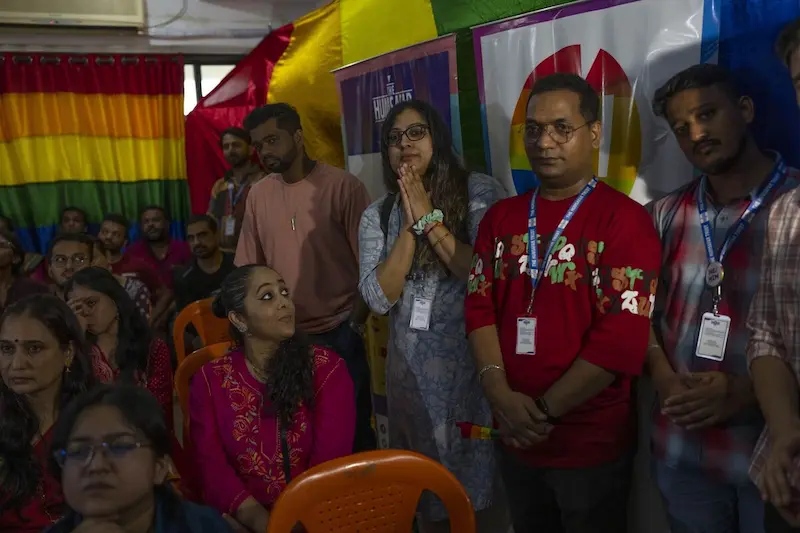


In a disappointing blow to millions of LGBTQ couples seeking equal rights, India's Supreme Court has refused to legalize same-sex marriage, stating that the issue should be addressed by Parliament rather than the judiciary. The five-judge bench unanimously agreed that marriage is not a fundamental right, as per a ruling delivered in New Delhi on Tuesday. Chief Justice D.Y. Chandrachud emphasized that the court does not have the authority to recognize LGBTQ marriages and that it is up to lawmakers to bring about a change in the law.
Although homosexuality was decriminalized in India in 2018, marriage rights have yet to be extended to the LGBTQ community. Currently, fewer than 40 countries, including only two in Asia (Taiwan and Nepal), recognize same-sex marriage. The outcome of India's case was closely watched across the region, particularly in Thailand and South Korea, where similar measures are under consideration.
The chief justice of India stated that while the institution of marriage is not static, and it evolves over time, it is not within the court's purview to create law. "It can only interpret it and give effect to it," he remarked. The Supreme Court has called on the government to establish a committee to examine the rights and entitlements of LGBTQ individuals, including assessing issues related to medical rights and financial benefits that were raised by the petitioners.
Anjali Gopalan, an activist and executive director of Naz Foundation, expressed her disappointment, stating that "we are back to where we began" in terms of LGBTQ rights. Naz Foundation was the organization that filed a Public Interest Litigation in 2001, which ultimately led to the historic decriminalization of homosexuality by the Supreme Court in 2018.
During the hearings earlier this year, the federal government opposed legalization, contending that the legislature should be responsible for deciding the issue. It also argued that same-sex marriage is contrary to Indian values.
Currently, marriage in India is governed by various codes, including the Special Marriage Act, a secular law that previously legalized intercaste and inter-religious unions. Lawyers representing the petitioners, who come from diverse backgrounds, urged the court to extend the provisions of the Special Marriage Act to same-sex couples.
In addition to denying the plea to legalize same-sex marriage, the apex court also affirmed that transgender persons in heterosexual relationships have the right to marry under existing laws. Two of the judges also expressed support for LGBTQ couples' right to adopt.
The main opposition party, Indian National Congress, stated that it would provide a detailed response after studying the judgment. Jairam Ramesh, a leader of the Congress party, asserted, "Indian National Congress has always stood with all our citizens to protect their freedoms, choices, liberties, and rights. We, as a party of inclusion, firmly believe in non-discriminatory processes—judicial, social, and political."
The petitioners argued that denying them the right to marry violated their constitutional rights and created challenges relating to inheritance and adoption. The government, during the hearings, offered to establish a panel to address these matters but avoided tackling the topic of same-sex marriage directly. However, government panels are often slow to enact change.
"I was expecting some civil rights. I did not think they would grant full marriage rights, but I was expecting some civil rights for sure," expressed Anjali Gopalan.