


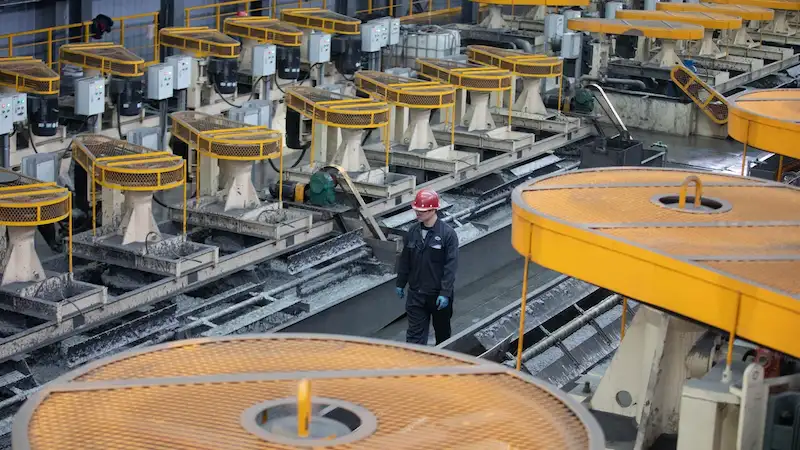


China has announced plans to impose restrictions on the export of graphite, a vital mineral used in the production of electric vehicle (EV) batteries. The move comes shortly after the United States imposed limits on the types of semiconductors American companies can sell to Chinese firms. These actions highlight the increasing trend of protectionist measures in the global trade arena, where actions and reactions are becoming pervasive. However, both sides are well aware of the high costs associated with prioritizing geopolitics over economics.
China, which currently dominates global graphite production and processing, has stated that export permits will be required for synthetic graphite materials, as well as for natural flake graphite, commencing in December. This includes high-purity, high-strength, and high-density variations. Carmakers are now seeking alternatives to Chinese graphite sources as they strive to secure long-term supplies in the face of escalating demand for EV batteries. The International Energy Agency reports that sales of EVs, including both fully electric and hybrid vehicles, exceeded 10 million units in 2021—an increase of 55% from the previous year. Sales are projected to reach nearly 14 million vehicles this year.
According to the US Geological Survey, the global market for graphite used in batteries has grown by a staggering 250% since 2018. China was the largest global graphite producer in 2021, accounting for approximately 65% of the world's production. Beyond EVs, graphite finds applications in sectors such as semiconductors, aerospace, chemicals, and steel.
China's imposition of export curbs on graphite follows mounting pressure from various nations concerning its trade and commercial practices. Over the past year, China has been embroiled in a technology war with the United States, as well as its allies in Europe and Asia, particularly regarding access to advanced chips and chipmaking equipment. In July, Beijing introduced export restrictions on gallium and germanium—essential minerals used in semiconductor production—which resulted in a complete halt of overseas shipments a month later.
Industry experts believe that the new rules regarding graphite exports are not a complete ban, as China had previously implemented temporary export controls with minimal impact on the industry. However, they predict that prices will rise due to supply and demand imbalances. Analysts at Counterpoint Research expect the average price of graphite to continue increasing, citing factors such as the ongoing supply disruptions caused by the Russia-Ukraine conflict, as Russia was one of the major graphite suppliers.
China's dominance in critical minerals needed for EV batteries is significant. The country refines 60% of the world's lithium and 80% of the cobalt, as reported by the US Department of Energy. These control over critical resources allows China to exert considerable influence over the global supply chain.
As tensions continue to escalate in the global tech battle, the latest export controls on graphite underscore the importance of diversifying sources for critical minerals. Car manufacturers are now actively seeking alternatives to reduce their reliance on China and secure stable supplies. However, the challenge lies in developing or expanding alternative graphite sources that can meet the growing demand associated with the rapidly expanding EV market.