


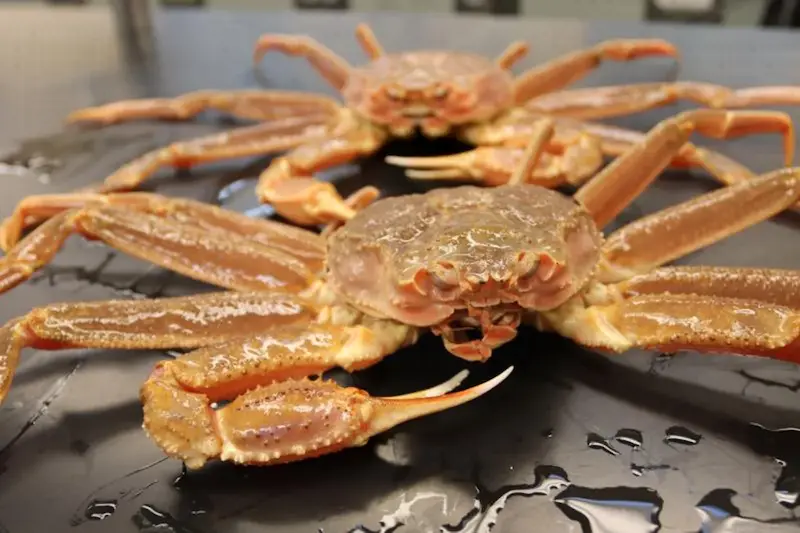


In a baffling turn of events, billions of snow crabs have mysteriously vanished from the waters around Alaska, and scientists now believe they have uncovered the reason behind the alarming disappearance. Warmer ocean temperatures, caused by climate change, are likely to blame for starving the snow crabs to death. This revelation comes hot on the heels of the Alaska Department of Fish and Game's announcement that the snow crab harvest season has been canceled for the second consecutive year due to the unprecedented absence of crabs in the usually icy waters of the Bering Sea.
A study conducted by researchers at the National Oceanic and Atmospheric Administration (NOAA), published on Thursday, has shed light on a significant correlation between recent marine heat waves in the eastern Bering Sea and the sudden decline of snow crabs observed since 2021. Lead author of the study, Cody Szuwalski, expressed his astonishment upon receiving the 2021 survey data, stating that everyone had hoped it was just an error and that the crab population would recover the following year. However, it became increasingly clear that this was not the case, leading to the closure of the US snow crab fishery in Alaska for the first time in 2022.
While overfishing has been touted as a possible explanation for the dwindling crab population, experts point out that this classification does not fully account for the collapse. The study's findings highlight the disruptive impact of climate change on the ecosystem, underscoring the fundamental need to reassess existing models and management systems in light of the rapidly changing environment. Szuwalski emphasized the need to acknowledge the menace posed by climate change, stating that fisheries scientists have historically focused on overfishing as the main concern, but it is now evident that climate change poses an even greater challenge.
The study employed a thorough analysis to determine whether the snow crabs had either migrated or perished. By examining areas north of the Bering Sea, as well as deeper sections of the ocean and even Russian waters, the researchers concluded that it was unlikely the crabs had relocated. Rather, they found a strong link between warmer temperatures, higher population density, and increased mortality rates among mature snow crabs. Cold-water creatures, snow crabs thrive in regions where water temperatures remain below 2 degrees Celsius. However, with warmer ocean waters disrupting their metabolism and elevating their caloric needs, the crabs struggled to find sufficient food to sustain themselves.
The study revealed a startling revelation: during the two-year marine heat wave that struck the Bering Sea region from 2018 to 2019, the crabs' energy requirements from food may have quadrupled compared to previous years. Unfortunately, the heat wave also disrupted the Bering Sea's food web, making it difficult for the snow crabs to find nourishment and keep up with their heightened caloric demands. This dire situation allowed other species, such as Pacific cod, to take advantage of the vulnerable snow crab population, penetrating their typically frigid habitat and further depleting their numbers.
The rapid warming of temperatures around the Arctic, four times faster than the global average, has resulted in the loss of sea ice, particularly in the Bering Sea. This amplified warming trend exacerbates the effects of climate change. Szuwalski explained that 2018 and 2019 saw an extremely abnormal decline in Bering Sea ice coverage, with only around 4% of the historical average. The future trajectory of ice coverage is uncertain, making it challenging to predict whether similar events will occur in the years to come.
The disappearance of Alaska's snow crabs serves as an alarming reminder of how the climate crisis is rapidly accelerating and adversely impacting the livelihoods of both humans and marine species. Szuwalski admits that he anticipated such devastating consequences would manifest in due course, but the suddenness of the population collapse caught him off guard. As the ice continues to recede, it is expected that the snow crab population will shift northward, resulting in reduced sightings in the eastern Bering Sea. The ongoing crisis calls for urgent action to address climate change and its catastrophic effects on our planet's delicate ecosystems.