


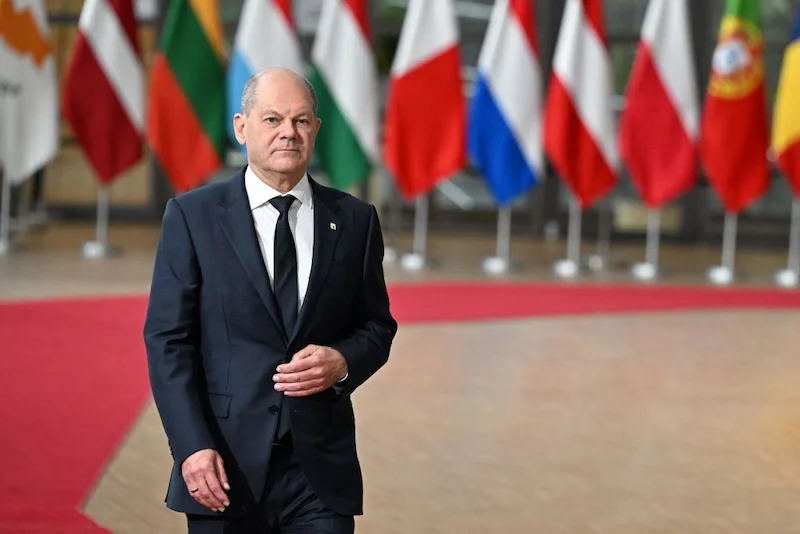


In a tense closed-door meeting, German Chancellor Olaf Scholz urged European Union leaders to take decisive action in limiting the bloc's spending plans. The discussions, which carried on late into Thursday night during a two-day summit in Brussels, witnessed clashes between EU heads and the bloc's executive arm. The EU Commission, led by Ursula von der Leyen, is seeking additional funding as its budget capacity shrinks due to multiple crises, including the Covid-19 pandemic and an energy crisis. The majority of the funds would be allocated to a mid-term financial package of €50 billion ($53 billion) for Ukraine.
Scholz, setting the tone early in the debate lasting around three hours, emphasized the need to discuss trade-offs and identify areas for potential cuts, as opposed to merely focusing on spending money. According to insiders familiar with the talks, while leaders expressed political support for Ukraine, there was generally little appetite for new spending. However, even providing funding for Ukraine is proving to be a challenge due to budget constraints in Brussels and member states. Slovakia's Robert Fico, along with Hungary's Viktor Orban, rejected granting additional funds to Ukraine.
French President Emmanuel Macron, after the summit concluded on Friday, acknowledged agreement with the commission's priorities concerning migration and Ukraine. He stated that while the proposed amount felt excessive, efforts would be made to reduce it without sacrificing crucial areas. EU member states are grappling with financial pressures resulting from increased spending to address the pandemic, the impact of the conflict in Ukraine, energy supply disruptions, and rising inflation. These pressures are further compounded by the reimposition of the EU's fiscal rules next year, necessitating tighter control over expenditure.
The planned mid-term financial package for Ukraine includes €33 billion in concessional loans. Migration is also a priority, with €15 billion sought for strengthening external borders and establishing new partnerships with neighboring countries. Furthermore, the commission wants €10 billion to enhance various sectors and leverage funds for the development of cutting-edge technologies, placing the EU in competition with the United States and China.
Both Macron and Belgium's Alexander De Croo emphasized the importance of budget discipline within the EU. De Croo highlighted the need for European institutions to review their own financial figures, especially when member states are being asked to bring their budgets in order.
The commission has warned that it would require additional resources to cover the increased borrowing costs resulting from the issuance of joint debt to finance the pandemic recovery fund. The amount could reach €20 billion, subject to annual agreement.
During the summit, several leaders reaffirmed their support for Ukraine, recognizing the potential impact of the ongoing conflict and the recent Israel-Hamas war on Kyiv's stability. Migration also emerged as a crucial priority, as Italy has expressed concern over shouldering the burden of immigrants arriving from North Africa.
Scholz emphasized the urgency of the situation, stating that no serious proposals were put forward, particularly regarding potential spending cuts. He called for immediate action, urging member states to begin working on this issue in the coming days.
Bulgaria's Finance Minister Nikolai Denkov stated in an interview that they preferred additional funding from member states rather than reallocation, which could create further tensions among EU nations.
The rejection of additional financial support to Ukraine by Orban and Fico drew public rebukes from fellow leaders. Estonia's Prime Minister Kaja Kallas questioned the alternative if Ukraine is not assisted, stating that allowing Russia to triumph would have far-reaching consequences.
Von der Leyen, during the discussions, highlighted the lack of funds and revealed that the commission was forced to use 2024 funding to address flooding in Slovenia earlier this year.
Following the summit, von der Leyen affirmed that the commission's priorities were widely accepted. However, she acknowledged the challenge of securing resources, suggesting that it could be through national contributions or redeployment from the EU budget.