


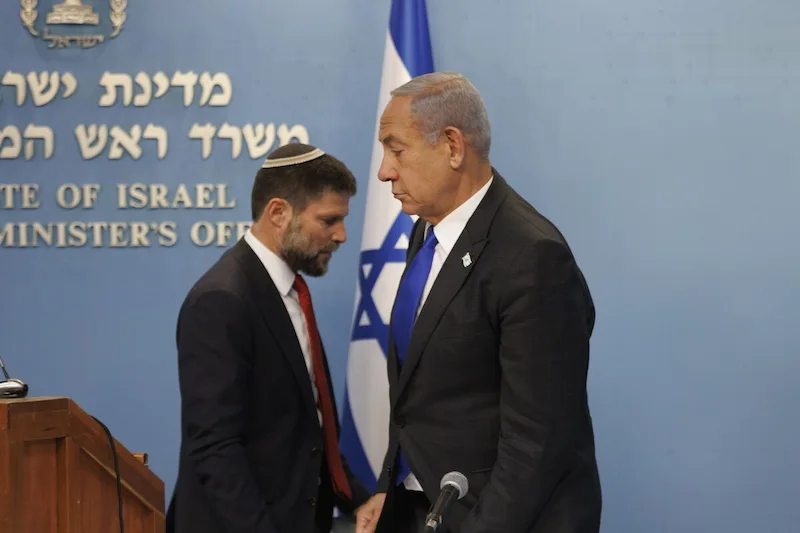


Israel's Prime Minister Benjamin Netanyahu finds himself in a challenging position as the ongoing conflict between Israel and Hamas takes a toll on the country's economy. With the war costing around $260 million daily, the already strained public finances are further burdened by controversial payouts championed by right-wing members of Netanyahu's ruling coalition. These payouts, known as "coalition funds," are allocated to religious schools and settlement projects in the occupied West Bank.
While the coalition funds represent a fraction of Israel's overall budget, they have become a contentious issue as the country grapples with its worst armed conflict in decades. The allocation of these funds will have a significant impact on how forgiving global markets will be towards Israel, which has already incurred an estimated economic toll of nearly $8 billion as a result of the war.
The cost to insure Israeli sovereign bonds against default has doubled since the start of the war, and the risk premium demanded by investors to hold Israeli dollar notes over US Treasuries remains elevated. The unprecedented funding for religious programs and settlements in the West Bank has drawn criticism even before the conflict, with concerns that it would hinder economic growth. Now, as Netanyahu vows to pay any economic price for the war, the need to reassess budget priorities becomes increasingly apparent.
Finance Minister Bezalel Smotrich is set to unveil a new budget that covers the remainder of 2023 and outlines plans for the next year. The proposed budget includes a significant increase in military spending, which will be financed through additional borrowing. However, the ruling parties have thus far resisted diverting the unused coalition funds or cutting programs associated with them, despite their high costs surpassing those of public hospitals and state-funded higher education.
Smotrich, a lifelong settler, has suggested making minimal adjustments to the budget, while maintaining funding for teacher pay hikes at orthodox schools and increasing expenditure on settlements. Investors and analysts have expressed their disapproval of this approach, urging the government to halt financing non-essential expenses and emphasize the prioritization of war-related expenditures.
The challenging economic outlook comes after a period of improvement in Israel's fiscal situation, where the country achieved its first budget surplus in over two decades last year. However, the deficit is projected to reach 4% of economic output in 2023 and 5% in 2024, significantly higher than previous forecasts. Moody's Investors Service forecasts an even higher deficit of 7.1%, adding to the concerns about the government's ability to effectively manage the budget.
The debate over coalition funds exposes a growing discord within the Finance Ministry. The budget department, staffed with technocrats who prioritize fiscal responsibility, has proposed stricter measures, including redirecting coalition funds and closing certain government ministries. These proposals are expected to face scrutiny from rating agencies as they assess Israel's economic stability.
As Finance Minister Smotrich takes on the task of crafting a new budget, he emphasizes the importance of structural reforms that promote economic growth. However, he also asserts the necessity of retaining funding for orthodox schools and increasing spending on settlements, citing the need for protection amid rising tensions in the West Bank. Critics argue that maintaining these favored expenditures, particularly for a constituency exempt from military conscription, sends a signal of weak governance capacity.
Former central bank governors Karnit Flug and Jacob Frenkel warn that failing to make significant changes to the budget could lead to a downgrade in Israel's credit rating. The government faces a challenging balancing act between political survival and managing the economic fallout from the war. As the country grapples with these competing demands, financial markets and rating agencies will closely monitor how Israel navigates these choppy waters.