


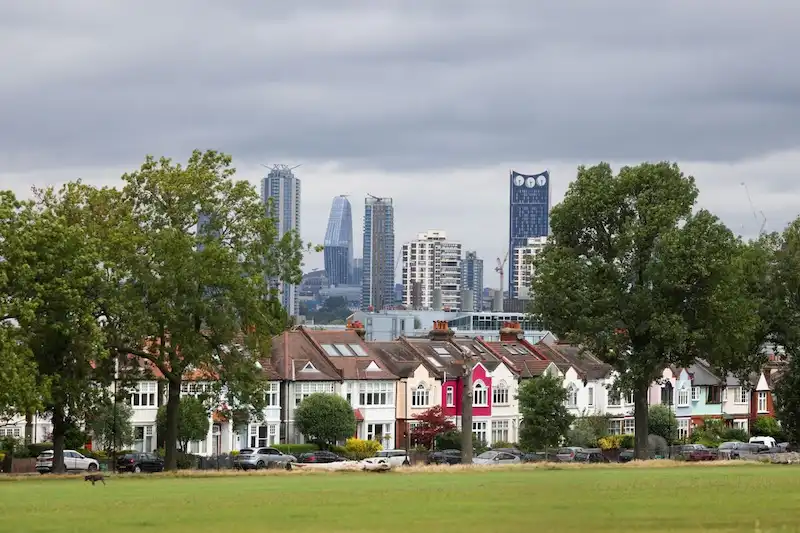


In a trend that has reemerged since the onset of the pandemic, young adults in their twenties are increasingly finding themselves priced out of the housing market in London. Recent data from real estate company Hamptons reveals that nearly half (48%) of renters in their twenties who have sought new apartments this year have chosen to move outside of the capital. This comes as rent prices surge, with a 16% year-over-year increase in September, outpacing the average 9% gain across Europe.
The higher costs are pushing even relatively well-paid young professionals to leave London, reinstating a years-long trend that temporarily reversed when the pandemic hit, according to Hamptons. Job Tabbush, a researcher at the UK think tank Centre for London, notes that "London increasingly stands out as a place where life for less affluent young people is no longer possible."
Rebecca Donaldson, a 26-year-old talent manager and lifelong Londoner, recently made the decision to relocate to Birmingham after her landlord raised her rent from £800 to an unaffordable £1,500. Earning less than £30,000 a year, she found it impossible to sustain her life in the city. Donaldson mentions the stigma associated with leaving London as a young person, stating, "There’s this idea that if you leave London when you’re young, it’s a failure on your part, so I’ve had to deal with that stigma. But I just couldn’t afford to live there anymore."
Several factors have contributed to the soaring rent prices in London. The elevated interest rates have increased mortgage costs for landlords and made it harder for potential buyers to enter the housing market, thus creating a higher demand for rental properties. Spareroom, a UK rental site, reports that in September, there was only one unit available for every six people looking to rent, making it one of the tightest markets in recent history. Consequently, bidding wars and long queues to secure a rental unit have become commonplace.
However, there are signs that the demand for rentals might be easing slightly as more people opt to move away from the city or reside with family members instead. Data from the Office for National Statistics indicates a 15% increase in the number of UK residents living with their parents over the past decade.
Returning to live with family can partially offset the higher costs, as wages fail to keep up with rising living expenses. According to the charity Trust for London, Londoners would need to spend 25% more per week to maintain the same standard of living as in 2020. In contrast, salary growth in London has only reached 5% during that same time period, according to the Institute for Fiscal Studies.
The impact of increasing rent prices is expected to transform London into a less diverse and older city over time, warns Christine Whitehead, a professor of housing economics at the London School of Economics. Data from the Office of National Statistics reveals that the disposable income gap between London and the UK average is at its highest point since 1997. Currently, the average London household has 43% more disposable income than the national average, compared to a 22% difference over 25 years ago.
Younger individuals are predominantly relocating to commuter towns near London, like Broxbourne in the northeast and Maidstone in the southeast, according to Hamptons data. Aneisha Beveridge, Head of Research at Hamptons, mentions that "rent rises are pushing tenants farther and farther out. Still, people do their best to remain as close to the capital as possible."
As London's rent prices continue to soar, it is clear that young adults are facing increasing difficulties in maintaining a foothold in the city. The consequences of these rising costs are likely to make London a less diverse and vibrant city, ultimately impacting its social and economic fabric.