


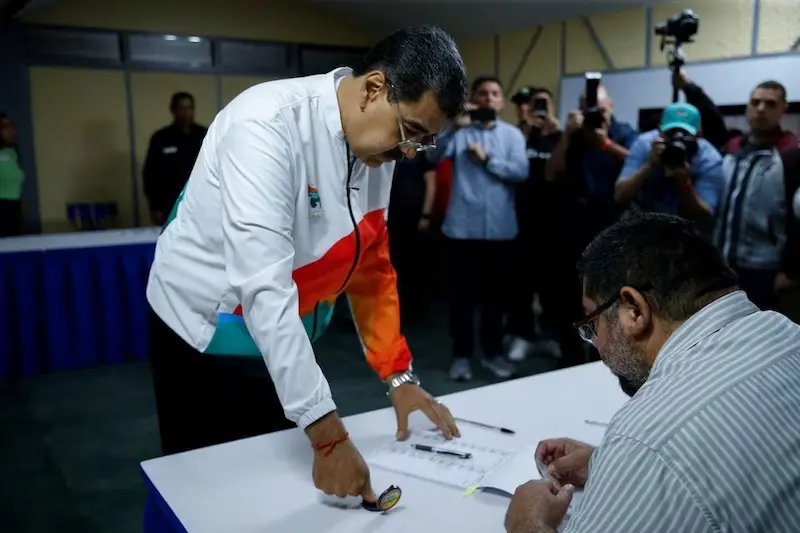


Venezuelans are preparing to participate in a referendum this Sunday regarding a long-standing border dispute with Guyana over a potentially oil-rich territory. The referendum, supported by President Nicolas Maduro's government, aims to gauge public opinion on the jurisdiction of the International Court of Justice (ICJ) in deciding the ownership of the area surrounding the Esequibo river. The vote is seen by some as a display of strength by Maduro and a test of his government's popularity ahead of the planned 2024 presidential election.
In April, the ICJ ruled that it had jurisdiction over the territorial dispute; however, a final decision may take several years to reach. Venezuela has consistently argued that the issue should be resolved through bilateral negotiations between the two nations. Subsequently, Guyana requested that the ICJ halt the forthcoming referendum. While the court did not explicitly prohibit the vote, it ordered Venezuela to refrain from taking any action that could change the current status quo. Both countries interpreted the ruling as a validation of their respective positions.
President Maduro has been actively encouraging voters to approve the referendum, aiming to convey a message of strength to Guyana. The disputed territory covers 160,000 square kilometers (61,776 square miles) of largely dense jungle. Venezuela renewed its claim over the area after the discovery of potential offshore oil and gas reserves. Maduro hopes that Guyana will adhere to a bilateral agreement from 1966 to resolve the dispute, while also considering future oil and gas developments. Additionally, the maritime border between the two countries remains in contention.
Political analysts predict that the referendum will be approved, as there is no organized opposing campaign in Venezuela, and those who disagree with the proposal may choose to abstain from voting. However, the referendum is consultative, which means there is no minimum number of votes required for its approval. Experts note that Maduro's government is conducting the vote primarily for internal purposes, to test its electoral machinery and gauge popular sentiment.
The anxiety surrounding the referendum is also palpable in Guyana, with the government urging citizens to remain calm. However, Friday's ICJ ruling brought relief for some in Georgetown, as they saw it as a positive decision. Meanwhile, Brazil announced on Wednesday that it had ramped up "defensive actions" along its northern border due to concerns stemming from the territorial dispute.
The outcome of this referendum will have significant implications for Venezuela and Guyana, not only in terms of borders but also potential oil and gas resources. Additionally, it will reflect the current support and strength of President Maduro's government and may impact the country's future political landscape.