


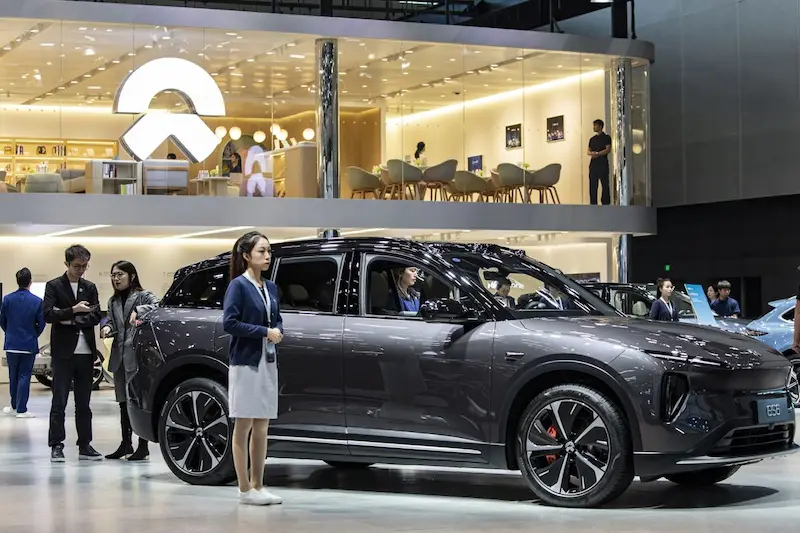


Chinese electric vehicle (EV) maker Nio Inc. has reported a quarterly loss and provided a below-estimate outlook on revenue and EV deliveries. The company's revenue projection for the three months ending in December falls short of analysts' average estimate, and its expected vehicle sales in the quarter are also lower than forecasts. Nio had set a target of shipping 250,000 EVs this year but has fallen significantly behind, having shipped only 142,026 as of November.
To address the current challenges, Nio is implementing cost-cutting measures and exploring strategies to boost sales. The company plans to cut or delay projects that do not contribute to its financial performance within the next three years. For instance, while Nio will continue its in-house development of cells, battery materials, and packs, it will outsource their production. In addition to recent workforce reductions, Nio aims to reduce expenses by approximately 2 billion yuan in 2024.
In November, Nio laid off 10% of its workforce and has also considered spinning off non-core businesses to trim costs. Despite receiving a 7% stake in June through a nearly $740 million investment from an Abu Dhabi government-backed fund, Nio sold $1 billion of convertible bonds in September and is reportedly considering raising an additional $3 billion.
While focusing on core technologies, Nio also plans to expand its sales and service networks, which will involve hiring more staff. The company currently employs around 5,700 people in sales, with over 3,000 of them being recent hires.
After Nio executives outlined the cost-cutting plans, the company's New York-listed shares rose by 3.7%. However, the stock has seen a decline of over 20% this year, underperforming compared to its Chinese EV rivals Xpeng Inc., which has gained 63%, and Li Auto Inc., which has surged 76%. Nio experienced immense growth in 2020, but its stock fell 69% in 2022 and 35% in 2021.
Nio, founded in 2014, distinguishes itself through its high-end showrooms called Nio Houses, offering luxurious lounge-like spaces where EV owners receive complimentary beverages and can participate in social events. The company is also partnering with competitors to generate more revenue, as evidenced by recent agreements with Chongqing Changan Automobile Co. and Geely Automobile Holdings Ltd. to collaborate on battery-swapping technology. Nio's CEO, William Li, has not ruled out the possibility of separately funding or listing its power swap business.
In the third quarter, Nio's revenue rose by 47% compared to the previous year, amounting to 19.1 billion yuan. The vehicle margin, which measures the profitability of recent car sales, returned to double digits in this quarter. Nio expects this measure to further improve to 15% in the fourth quarter and potentially reach 18% in 2024.
Furthermore, Nio has announced its intention to acquire manufacturing equipment and assets from Anhui Jianghuai Automobile Group Corp. for 3.2 billion yuan. This move aligns with Nio's recent approval from the Chinese government to independently manufacture automobiles. Taking production in-house is expected to reduce overall manufacturing costs by approximately 10%, according to CEO William Li.