


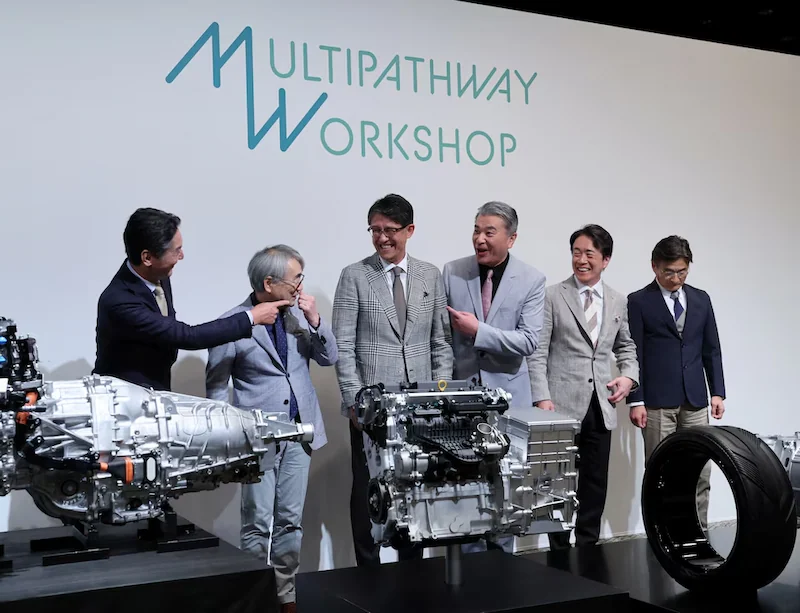


On Tuesday, Toyota Motor, worldwide leader in automobile manufacturing, unveiled its next-generation engines specifically designed for an array of vehicles from hybrid to biofuel-run cars. Significantly contributing to the decarbonisation efforts of the industry, this move is in response to stricter emission regulations and it also reinforces Toyota's strategy to market an expansive variety of vehicles instead of only focusing on electric vehicles (EVs).
The initiative was revealed at a press event shared with Subaru and Mazda Motor, who are significant stakeholders of Toyota. The newly devised engines, with a 1.5 litre and 2.0 litre capacity, were displayed and are predicted to markedly decrease the volume and height of engines currently in production.
In a collective statement, the three automobile giants expressed their ambition to optimize the integration of batteries, motors, and other electric drive components with these in-development engines. They aim to make internal combustion engines more environmentally friendly by enabling them to accompany e-fuels and biofuels. Moreover, they anticipate that these streamlined engines will revolutionise vehicle design by enabling lower bonnets.
Although Toyota was previously criticized for lagging in EV development, it has seen a resurgence aided by the slowed growth in the EV sector and an increased interest in petrol-electric hybrids. This latest development reflects a similar move by Mercedes-Benz, while BYD is to reveal novel hybrid technology with reduced fuel consumption.
Toyota's 1.5 litre engine is designed to show a reduction of 10% regarding weight and volume compared to its currently used 1.5 litre engines, evident in its Yaris compact variant. The new 2.0-litre turbo engine is expected to reflect identical advancements in comparison to the prevailing 2.4 litre turbo engines prevalent in larger models such as SUVs with three-row seating. Toyota's CTO, Hiroki Nakajima, refrained from divulging the time frame for the vehicles' launch equipped with the new engines.
Stringent emission rules known as "Euro 7" are being developed by policymakers in the EU aiming to ban the sale of new CO2-emitting vehicles by 2035. Though electric vehicles have gained popularity, Toyota continues to pursue a varied strategy catering to different vehicle powertrains, having sold roughly 2.4 million vehicles in the first quarter of the year, of which around 40% were petrol-electric hybrids. All-electric vehicles, fuel-cell, and plug-in hybrid vehicles collectively constituted just 2.9% of the total sales.
Chairman Akio Toyoda previously projected in January that EVs would constitute at most 30% of the global auto market share, with hybrids, vehicles running on hydrogen fuel cells, and fuel-combustion vehicles making up the remaining.