


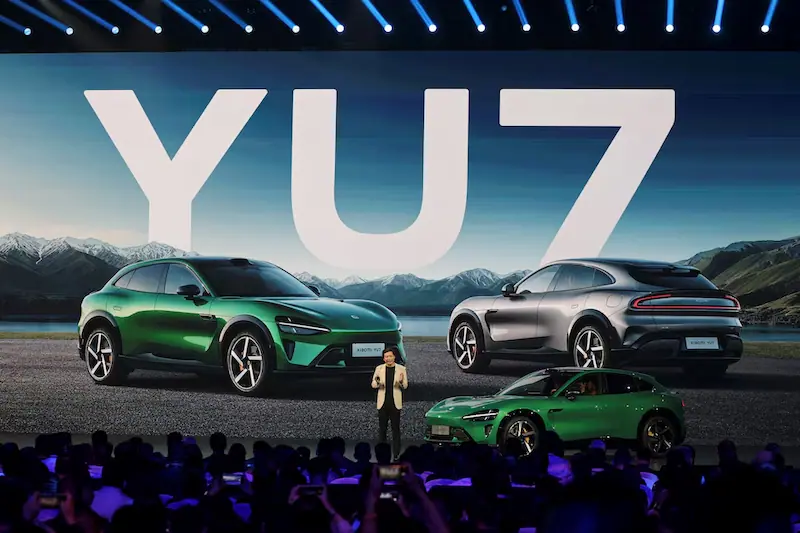


It’s not often that a smartphone company shakes up an entire industry. But Xiaomi, a name once strictly tied to phones and home gadgets, is rewriting the rules in China’s electric vehicle arena—and doing so with confidence that borders on audacity.
Their latest move? The launch of the YU7 electric SUV, a sleek, feature-packed vehicle that undercuts Tesla’s Model Y on price and, in some ways, outpaces it on performance. And the reaction? Let’s just say it was anything but quiet.
In less than a day—18 hours, to be exact—Xiaomi racked up about 240,000 pre-orders for the YU7. That’s not just window-shopping enthusiasm. Buyers either shelled out a full deposit for immediate delivery or a smaller one to secure a future unit. In a market as competitive and saturated as China’s EV scene, those numbers turn heads.
The buzz spilled into Xiaomi showrooms across the country. In Beijing, a small crowd surrounded the YU7 like it was the newest iPhone. One onlooker, Otto Shi, already drives a Tesla Model Y. But even he was seriously considering buying the YU7 for his father—proof that brand loyalty isn’t what it used to be. “Xiaomi nailed it with the SU7,” he said. “It made me trust they’re not just playing around.”
That earlier SU7 sedan was no fluke. Since its March 2024 debut, it has consistently outsold Tesla’s Model 3 on a monthly basis in China, and even won public praise from Ford CEO Jim Farley, who isn’t known for handing out compliments lightly.
With the YU7 starting at around $35,360, Xiaomi has made it even harder for Tesla to keep its grip on the world’s largest EV market. Analysts are now saying what Tesla doesn’t want to hear: price cuts may be coming. Possibly even more incentives. Citi analysts suggest Tesla might have to offer its advanced driver software for free and boost financing perks to compete.
Tesla’s slice of the Chinese EV pie has been shrinking—down to just 7.6% in early 2025, from 15% back in 2020. The local brands are catching up fast, and Xiaomi, once a newcomer, is emerging as a serious threat.
Xiaomi CEO Lei Jun isn’t shying away from the comparison. While he acknowledged Tesla’s lead in driver assistance tech, he quickly pointed out areas where the YU7 pulls ahead. For example, it boasts a bigger battery—96.3 kWh versus Tesla’s 78.4 kWh—which gives it a longer driving range: 835 km to the Model Y’s 719 km. It also charges faster, and throws in some thoughtful perks, like under-seat storage drawers and free smart driving features, whereas Tesla still asks over $8,800 for theirs.
The market clearly took note. Xiaomi’s stock surged to a record high before settling with a strong 3.6% gain. It’s already up over 70% this year, lifting the company’s valuation close to $190 billion. Among large-cap stocks in Asia Pacific, it’s currently the top performer.
But the stampede for orders has a downside. Not everyone wants the YU7 to drive it. On Xianyu, a popular secondhand marketplace, scalpers are already reselling their order spots—sometimes at a hefty markup. Xiaomi, not wanting the car to become a hype-fueled currency, has now capped purchases to two vehicles per buyer.
The bottom line? Xiaomi has done more than release a new car. It has thrown a challenge at Tesla’s feet, one that’s being taken very seriously. A tech company-turned-car-maker just disrupted the playbook. And the world is watching to see how far they’ll go.