


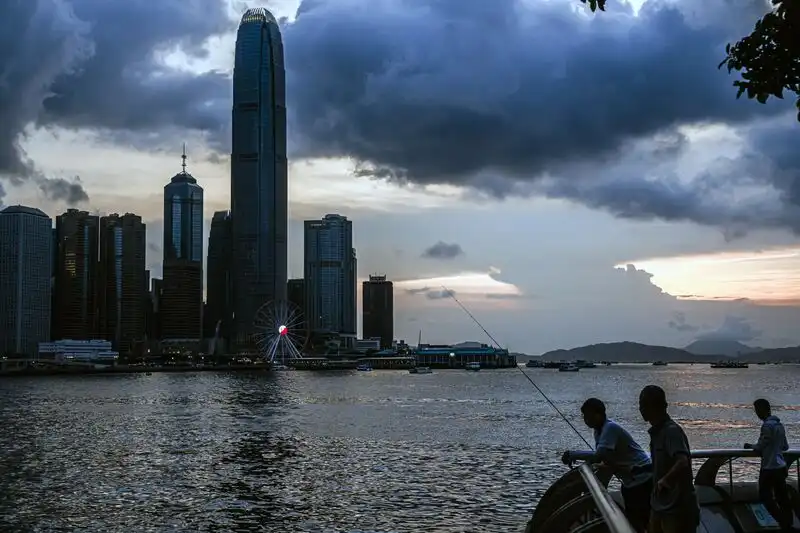


Six months after Hong Kong reopened to the world, the city is facing an uphill battle to reclaim its position as Asia's premier finance and tourism hub. Chief Executive John Lee, a former policeman, has been making concerted efforts to revive Hong Kong's reputation through high-profile events, new visa programs to attract top talent, tax concessions for the wealthy, and free airline tickets for visitors. However, rebuilding the city's once-renowned status as Asia's World City will prove challenging. The exodus of tens of thousands of skilled workers, seeking refuge from the city's Covid regime and Beijing's imposition of the national security law in 2020, has resulted in a significant labor shortage.
Moreover, global market conditions and concerns of an impending recession have further dampened Hong Kong's prospects. Tensions between China and the US have diminished the city's allure, while the recent banking crisis, including the collapse of Credit Suisse Group AG, has added more pressure to the already struggling financial industry. Major international banks, such as Goldman Sachs Group Inc., have implemented substantial job cuts in dealmaking roles focused on China and Hong Kong as part of a wider global downsizing strategy.
Hong Kong's strict quarantine measures, closely mirroring China's approach to combating Covid, have severely impacted the finance industry and triggered an outflow of bankers. Consequently, Singapore has emerged as the primary beneficiary, experiencing a surge in hedge funds and family offices, consequently dethroning Hong Kong as Asia's leading financial center in the Global Financial Centres Index.
To revive the industry, Hong Kong is now seeking to attract cryptocurrency firms and enticing more family offices with tax incentives. However, progress has been slow. While the influx of professional talents has shown some signs of reversal, financial institutions require time to devise new strategies, and the recent banking turmoil has dented overall confidence. The implementation of the Top Talent Pass, a visa program designed to attract skilled workers, has seen approximately 84,000 applications as of May, with around 49,000 approved, according to Chief Executive John Lee.
Once hailed as the world's largest market for initial public offerings (IPOs), Hong Kong's dealmaking activities have significantly dwindled. In 2020, the city's exchange witnessed a staggering 70% plunge in fundraising compared to the previous year. Despite expectations that escalating tensions between the US and China would drive more mainland firms to list in Hong Kong, this year has seen a continuation of the slump. Data compiled by Bloomberg reveals that companies have debuted a total of $2.24 billion in shares as of June-end, marking a 17% decline compared to the same period a year ago. In a bid to revive business, officials have lowered the listing thresholds for advanced technology firms and have been actively courting potential issuers from the Middle East. However, President Xi Jinping's increased control over the nation's technology industry raises uncertainty and poses a risk. Chinese firms continue to dominate IPO fundraising, accounting for 97% and 98% of the total amounts raised in 2020 and 2021, respectively. In 2021, China-based companies accounted for 88% of the total raised through IPOs, with the 16 largest IPOs all being China-based.
The demand for office space in Hong Kong has slumped amidst cost-cutting measures and job reductions by banks, coupled with the slowdown in dealmaking and the relocation of certain multinational companies. The overall grade A vacancy rate in Hong Kong reached nearly 15% in April, more than three times higher than in 2019, according to Colliers International Group Inc. This trend is particularly evident in the prestigious financial district of Central, which has seen an increase in available space for the first time in over a decade. While the reopening of the border with mainland China may have a positive long-term effect, analysts predict that rents will still decline by 10% in 2023 due to the high vacancy rate and uncertainties surrounding Hong Kong and China's economies. However, there are signs of hope in the retail sector, with a mall in the prominent shopping district of Tsim Sha Tsui leasing three floors to a dining and entertainment group for an impressive monthly sum of nearly $900,000, the largest lease in terms of size and value since the pandemic.
Unlike the office sector, the housing market in Hong Kong has fared better. The reopening of the border has boosted sentiment, as mainland Chinese buyers are expected to invest in properties in the city. Home prices have risen by 6.3% so far this year, although they have not fully recovered from the 16% decline in 2021, according to data from Centaline Property Agency. However, the recovery may be short-lived as interest rates begin to rise. In May, home sales were 35% lower compared to the same period in the previous year, indicating a decline in market activity. Moody’s Investors Service predicts that residential prices will largely remain stagnant in the second half of the year due to higher interest rates, increased volatility in the capital markets, and a rise in completed housing projects.
Hong Kong's efforts to lure back tourists have thus far been disappointing. While the number of visitors has increased from near-zero levels in recent years, the anticipated crowds thronging the city's shopping streets, malls, and high-end restaurants have been slow to materialize. In the first half of this year, the number of visitors reached almost 13 million, compared to a pre-pandemic average of 60 million per year. The government's strategy to attract conferences and major events, including Art Basel and the Rugby Sevens, has shown some progress. Additionally, the inaugural Wealth for Good summit saw the participation of over 100 family offices, with officials offering tax breaks and other financial incentives to encourage the wealthy to establish a presence in Hong Kong. Although business is slowly picking up, banks have extended their opening hours to accommodate the influx of visitors. Insurance sales to mainland visitors have surged nearly 28 times in the first quarter, amounting to HK$9.6 billion ($1.2 billion), approximately 75% of the level recorded in the same period in 2019. This boost has positively impacted China Life (Overseas), as well as other global competitors such as Prudential Plc and AIA Group Ltd.