


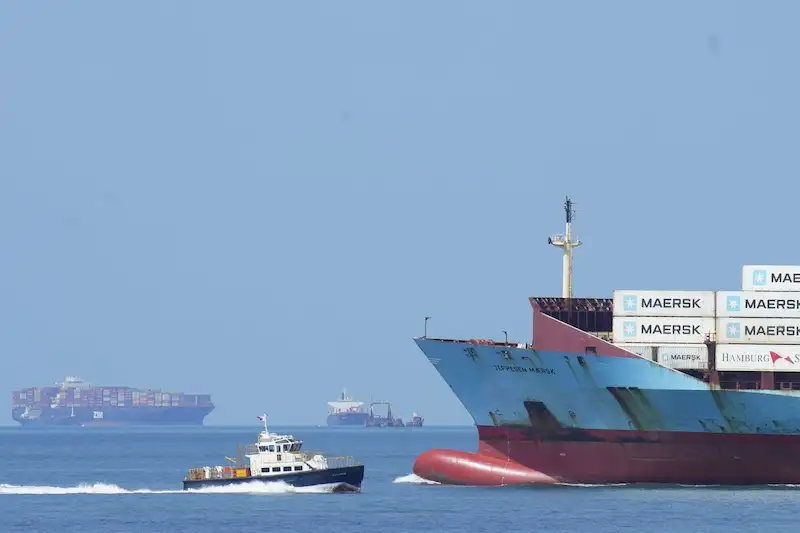


One of the world's most important trade routes, the Panama Canal, is facing a significant challenge due to the effects of climate change. The canal, which serves as a shortcut between the Atlantic and Pacific oceans, is experiencing reduced water levels that are forcing ships to part-load in order to navigate through. This situation has resulted in vessels waiting for extended periods, with an average delay of almost 4 days compared to just over a day two months ago. In some cases, ships have even had to endure delays of up to 20 days.
The Panama Canal is a crucial lifeline for global trade, facilitating the transportation of over half a billion tons of cargo each year. It handles a wide range of goods, including Latin American crops and US energy, and is heavily relied upon by container ships transporting manufactured goods across the world. The current situation at the canal serves as a stark reminder of how a warming planet is disrupting global trade.
This summer has witnessed record-breaking temperatures and devastating wildfires across various parts of the Northern Hemisphere. In Europe, the Rhine river experienced seasonal lows last month, impacting the economy of Germany, the continent's largest economy. A.P. Moller-Maersk A/S, a major shipping company, recently warned that draft restrictions may be imposed on ships transiting Brazil's Amazon River from September to December.
In addition to the delays caused by low water levels, stricter restrictions implemented by local authorities have further reduced the number of ships passing through the canal. As a result, there is little room for accommodating additional ships at this time, as stated by Peter Sand, chief analyst at Xeneta, an ocean and air freight market analysis company.
One consequence of the reduced water levels is the need for ships to reduce their drafts, resulting in carrying less cargo than their capacity allows. Lake Gatun, the primary water source for the canal, reached a seven-year low depth at the end of July. Despite the onset of Panama's rainy season, the water levels are expected to remain below the five-year average until the end of October.
To address the situation, the Panama Canal Authority has not only insisted on lower-draft shipments but has also reduced the booking slots for the largest vessels. In combination, these restrictions have led to a decrease in the daily transit of containers through the canal.
As a result, shippers are exploring alternative routes. Some are considering using inland railways to offload goods shipped to the US West Coast and transfer them across the country. However, if the trend of lower container loads continues, there is a risk of delays in restocking inventories ahead of the Christmas season, according to Container xChange, a container logistics platform.
The impact of the reduced capacity at the Panama Canal extends beyond North America. Approximately 40% of containers shipped from Asia to Europe pass through the canal, further exacerbating the potential consequences. Furthermore, commodity markets are also being affected, with rising rates for ships transporting refined fuel and liquefied petroleum gas due to limited availability caused by congestion at the canal. Container ships are being prioritized, resulting in delays for other types of vessels.
In response to the situation, some ships are choosing to circumvent Panama's congested canal altogether. International Seaways, a tanker owner, redirected one of its ships traveling from Argentina to the US West Coast around the southern tip of South America to avoid potential delays and increased fees at the canal.
The critical issue of low water levels at the Panama Canal is a problem that cannot be ignored. Oystein Kalleklev, CEO of shipping company Flex LNG, emphasized its significance, stating that the congestion in Panama is an ongoing problem that needs to be addressed promptly.