


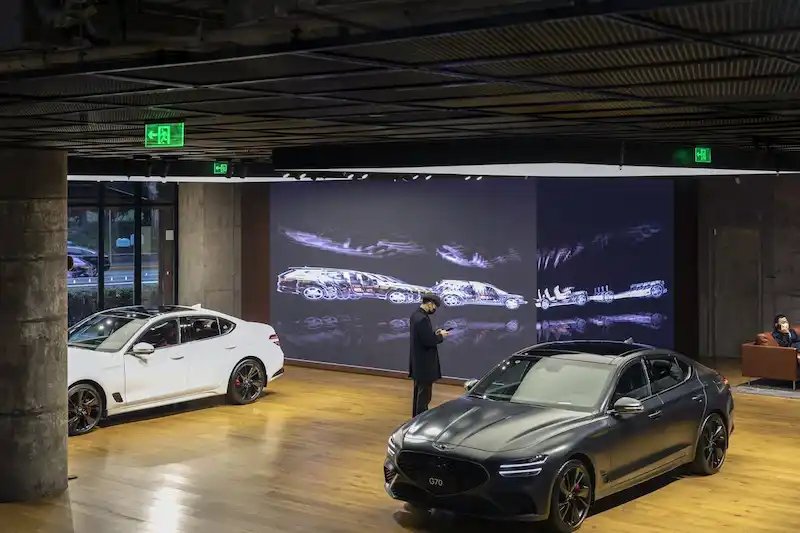


Hyundai Motor Co. and its affiliate Kia Corp. have been experiencing a remarkable year with record-breaking profits and surging sales worldwide. However, their success story hits a roadblock in China, where they are facing a lackluster performance that raises concerns about their future in the largest auto market in the world.
The sales of these Korean carmakers have plummeted in China due to a fierce price war and the rapid transition to electric vehicles (EVs). This decline is visible, with Hyundai reducing its manufacturing facilities in the country by more than half and trimming down its lineup of models from 13 to just eight, mostly focusing on premium offerings.
Although Hyundai and Kia have been struggling with declining sales in China for over five years, the first seven months of 2023 have been the worst in at least 15 years, according to the China Automotive Technology and Research Center. The once dominant car group, which commanded around 10% of the Chinese market in its heyday in 2009, now holds less than 2% of the market share.
The companies now face the difficult task of determining how they will operate in the Chinese auto market, which constitutes only 5% of their total sales. Despite the disappointment in China, Hyundai reported its highest quarterly profit in history for the three months ending in June and achieved record earnings in 2022, primarily driven by the popularity of models like the Ioniq 5 EV in Europe and the Tucson SUV in the US.
However, expanding their market share in China would require Hyundai to reduce supplies to the US and Europe, a decision that would involve sacrificing the higher profit margins in those markets. This poses a significant dilemma for the company, as it has to weigh the potential gains in China against the potential losses in other crucial regions.
Hyundai is not the only international automaker facing challenges in China. Stellantis NV closed its only Jeep factory in China last year, while Volkswagen AG and General Motors Co. are also grappling with tough competition from local manufacturers, notably BYD Co. Yet, Hyundai faces a unique double dilemma in China: its prices are too high to compete with domestic brands, and its perceived quality and reputation fall short compared to Japanese automakers, according to experts.
Politics may have also worsened the situation for Hyundai in China. Tensions rose in 2017 when anti-Korean sentiment surged over the deployment of a US anti-missile system in South Korea. This led to retaliatory measures against Korean products, including Hyundai cars. The company has struggled to fully recover since then, as auto sales slowed down and the Chinese market rapidly embraced EVs. Today, the EV market in China is dominated by local brands, with Tesla Inc. being the only foreign automaker ranked among the top 10 EV manufacturers in 2022, according to BNEF.
Despite these challenges, Hyundai remains committed to the Chinese market and is focused on improving sales momentum and brand perception. The company offers various options, including popular SUVs like the Palisade and luxury models under its Genesis brand. It aims to deliver Chinese customers a unique Hyundai EV experience, highlighting advanced technology and innovative design.
In terms of EVs, Hyundai and Kia sold only around 300 units in China in 2022, compared to 1.8 million sold by BYD and roughly 439,000 sold by Tesla. Additionally, the Korean brands significantly lag behind Toyota Motor Corp. and Honda Motor Co. in terms of EV sales in the Chinese market.
Hyundai embraced electrification faster and more aggressively than its Japanese counterparts and some European automakers, but it was slower than Chinese players to invest in EVs. The company's early focus on hydrogen vehicles, rather than battery-powered cars, was a misstep. Chinese automakers have excelled in self-driving technologies and offer a wide range of EV options, from luxury to budget models.
Retreating from the largest EV market would undoubtedly tarnish Hyundai's image and potentially hinder its progress as the world continues to adopt clean energy solutions. Being considered a "loser" in the EV competition would have global repercussions for the automaker's reputation.