


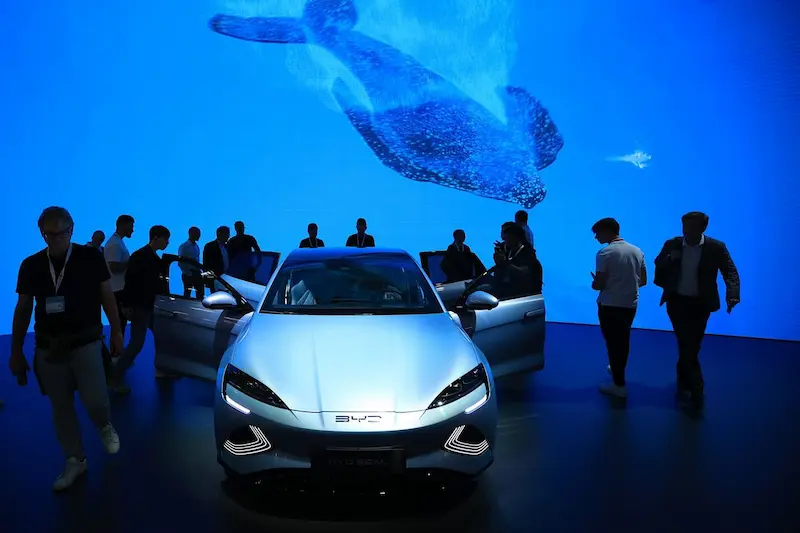


Chinese electric vehicle (EV) manufacturers are facing the challenge of winning over European consumers who are unfamiliar with their brands and skeptical about their quality and reliability. Unlike European carmakers who have been moving towards direct sales, Chinese EV makers like BYD, Xpeng, and Great Wall Motor are placing their bets on the traditional dealership model. They believe that establishing strong sales and service networks through dealerships will help them gain the trust and reputation they need to compete with established brands.
According to Daniel Kirchert, the head of e-mobility consultancy Noyo, the lack of brand recognition is a significant hurdle for Chinese carmakers in Europe. They need to convince European consumers that their cars are on par with the likes of Tesla, but at a more affordable price. Currently, Chinese EV makers have only managed to capture a small share (5.6%) of the European market for pure-electric and hybrid cars. The majority of these sales have come from MG Motor, a brand associated more with its British heritage than its Chinese ownership.
The success or failure of Chinese EV brands in Europe will depend on their ability to convince consumers to deviate from well-established automakers such as Volkswagen, Renault, and BMW. They believe that traditional car dealerships play a crucial role in establishing customer relations and building trust. Xpeng Inc.'s Germany manager, Markus Schrick, emphasized the importance of dealerships as the face of their brand.
Political tensions between China and the European Union could further complicate matters for Chinese EV makers. The EU has launched an investigation into China's state support of its EV industry, which could lead to new tariffs on Chinese EV imports. This could jeopardize their competitive edge and make building strong relationships with dealerships even more crucial.
BYD, China's largest carmaker, entered the European market through Norway in 2021, and its Atto 3 model became the top-selling EV in Sweden in July. However, its presence in Germany, Europe's largest auto market, is still limited with only 15 dealer locations. BYD aims to expand its footprint in Germany and establish a nationwide presence. To increase brand awareness, the company has partnered with rental company Sixt to provide 100,000 EVs through 2028 and has already opened 150 stores across Europe. However, they remain focused on building a distribution network through traditional car dealers.
Similarly, Great Wall Motor Co., which plans to produce the new electric Mini Cooper with BMW, has partnered with Emil Frey, the EU's largest car dealer group, to distribute its Ora and Wey cars. Xpeng also follows this model to sell its P7 sedan and G9 SUV, aiming to have up to 20 dealerships by the end of this year and double that number by 2024.
Chinese brand MG, owned by SAIC Motor Corp., has already established a strong presence in Europe with over 100,000 vehicles sold last year and more than 800 distribution points at local car dealers across Europe and the UK.
While Europe has seen a few successful newcomers in the past, such as Toyota and Hyundai, who slowly gained market share without posing a significant threat to established brands, the shift to EVs promises unprecedented opportunities for new entrants. Tesla's success has demonstrated that consumers are open to alternative brands. However, it remains to be seen if Chinese EV brands can match the marketing prowess of Elon Musk. With China's strong position in the battery supply chain, they are well-positioned to increase their market share.
The Chinese newcomers are also offering flexible ownership options, such as Lynk & Co's monthly subscriptions, to entice buyers. Despite the industry's shift towards online sales, traditional car dealerships remain central due to their customer relationships and services. However, the number of car dealers in Germany has been shrinking, and consolidation in the industry could pose risks for both dealerships and Chinese EV makers.
Where Chinese EV brands will stand in a few years will depend on the next couple of years. Market share by the end of the decade could range from 5% to 20%. Recreating Tesla's success will be a challenge, but not impossible, according to analysts. The presence and success of Chinese EV brands in Europe will continue to evolve in the coming years.