


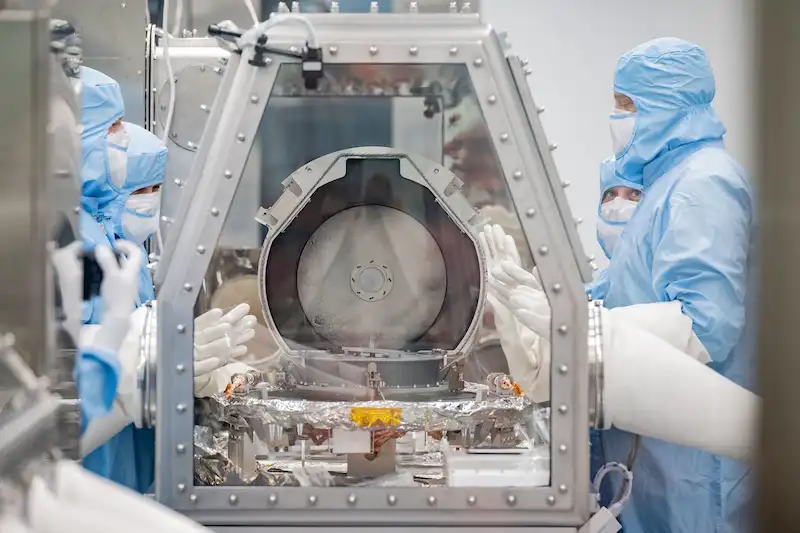


Scientists have made a remarkable discovery while examining a sample obtained from the near-Earth asteroid Bennu. The canister containing the sample was opened on September 26, revealing an unexpected abundance of dark, fine-grained material on the lid and base of the container. This surprising debris offers valuable insights into Bennu's composition and could provide crucial information about the asteroid's origins.
The landing of the Bennu sample in the Utah desert on September 24 marked the successful completion of NASA's 7-year OSIRIS-REx mission. The spacecraft traveled about 200 million miles from Earth to Bennu, touched down on the asteroid's surface, and then returned to Earth to drop off the sample. This incredible journey covered a total distance of approximately 3.86 billion miles.
The canister containing the sample was promptly transported to NASA's Johnson Space Center in Houston, where it was placed in a specially designed clean room for meticulous analysis. Scientists are eager to uncover the secrets held within the asteroid sample, as it could shed light on the early days of our solar system's formation. Studying asteroids like Bennu provides valuable insights into the chaotic processes that occurred during the formation of our planets.
Apart from their scientific significance, near-Earth asteroids like Bennu also pose a potential threat to our planet. By understanding their composition and orbits, scientists can develop strategies to deflect any space rocks on a collision course with Earth. This makes the analysis of the Bennu sample even more crucial.
During the mission, OSIRIS-REx used its Touch-and-Go Sample Acquisition Mechanism (TAGSAM) to disturb Bennu's surface and collect the sample in October 2020. It was evident that the collection was successful, as particles could be seen drifting off into space before the sample head was secured in the canister. Scientists took this as an opportunity to conduct a preliminary analysis of the material found outside the TAGSAM head.
The plentiful material discovered on the lid and base of the canister has the potential to provide significant information about Bennu. However, the scientists need to exercise patience and precision as they carefully collect all the material, including the bulk sample located within the mechanism head. The excess material indicates that there is more than expected, which is a positive "problem" to have, according to Christopher Snead, the deputy OSIRIS-REx curation lead.
The revealing of the actual asteroid sample is scheduled for October 11 in a live NASA broadcast. At that time, the TAGSAM head will be transferred to a specialized glovebox for careful disassembly, allowing for a proper examination of the sample it contains. Meanwhile, a quick-look analysis of the material found outside the TAGSAM head is already underway. This preliminary analysis will provide initial findings about the composition of the sample collected from Bennu.
Advanced scientific techniques, such as scanning electron microscopes, X-rays, and infrared instruments, will be employed for a detailed examination of the sample. These sophisticated tools will allow scientists to determine the chemical composition of the sample, identify any hydrated minerals or organic particles, and analyze the abundance of specific minerals present on the asteroid. The goal is to gather as much data as possible, down to the atomic scale, in order to gain a comprehensive understanding of the material collected from Bennu.
The initial analysis will provide researchers with crucial insights that will help them prepare for the thorough examination of the bulk sample. One of the primary objectives is to investigate whether asteroids like Bennu delivered essential elements, such as water, to Earth during its early formation. Additionally, studying this pristine sample could provide answers to lingering questions about the origins of our solar system.
While the scientific community eagerly awaits the unveiling of the asteroid sample, the spacecraft that delivered it, now named OSIRIS-APEX, is embarking on a new mission. It is on its way to study the near-Earth asteroid Apophis, which is expected to come close enough to Earth in 2029 to be visible to the naked eye. This continued exploration of near-Earth asteroids promises to expand our knowledge of the universe and our place within it.