


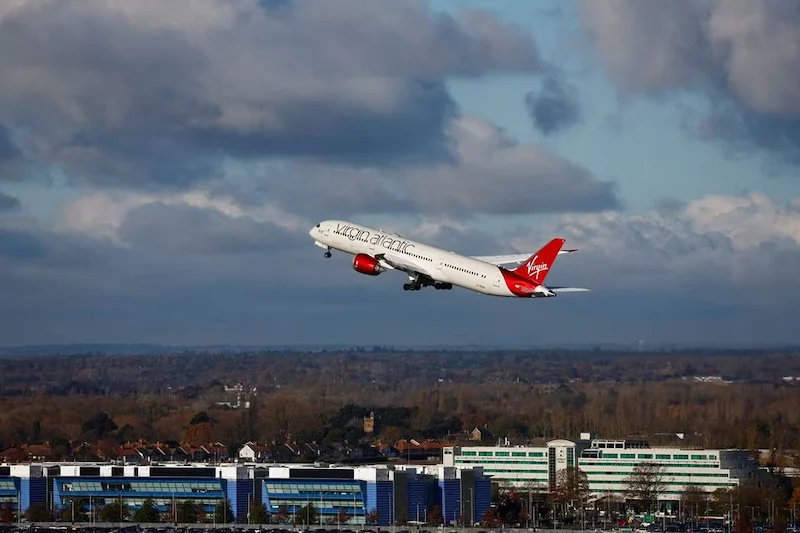


In a significant step towards decarbonizing the aviation industry, Virgin Atlantic has embarked on its first transatlantic journey powered entirely by sustainable aviation fuel (SAF). Departing from London, a Virgin Boeing 787 equipped with Rolls-Royce Trent 1000 engines took flight on Tuesday, bound for New York. The demonstration flight aims to showcase the potential of low-carbon options in securing the future of air travel.
As the world seeks to reduce carbon emissions, airlines are increasingly turning to SAF made from waste materials to slash their emissions by up to 70%. This enables them to continue operations until electric and hydrogen-powered aircraft become a viable reality in the coming decades. Aviation currently accounts for an estimated 2-3% of global carbon emissions, making SAF crucial in achieving significant reductions. However, the high cost of SAF, currently ranging from three to five times the price of regular jet fuel, and its limited availability, accounting for less than 0.1% globally, pose challenges for widespread adoption.
The Virgin Atlantic flight, dubbed Flight100, is a pioneering breakthrough as it marks the first time a commercial airliner has flown long haul using 100% SAF. Notably, this significant achievement is limited to a demonstration flight without paying passengers or cargo. Upon its return to Britain, the aircraft will utilize conventional jet fuel. Current certification limits SAF usage in commercial aircraft to a maximum of 50%, with most flights blending in SAF at lower percentages.
Onboard the historic flight are notable figures such as Virgin Atlantic's founder, billionaire Richard Branson, the airline's CEO Shai Weiss, and Britain's transport minister Mark Harper. Departing at 1149 GMT, the flight is scheduled to arrive at New York's John F. Kennedy International Airport at 1440 EST (1940 GMT).
The SAF used for this flight is primarily derived from waste sources such as used cooking oil and waste animal fat. A small amount of synthetic aromatic kerosene, made from waste corn, is also blended into the fuel composition. The success of ground tests enabled Virgin Atlantic, in collaboration with Rolls-Royce, Boeing, BP, and other partners, to gain permission for this exclusive use of SAF.
While demonstration flights have occurred in the past to draw attention to emissions reduction efforts, the aviation industry faces significant challenges in meeting its sustainability targets. Several European airlines, including Virgin, British Airways (owned by IAG), and Air France, have expressed interest in reaching a 10% SAF utilization target by 2030. Achieving the industry's ambitious goal of "net zero" emissions by 2050 hinges on increasing SAF's share to 65%.
However, industry analysts caution that attaining the 2030 target remains challenging due to the limited availability and high cost of SAF. In October, the CEO of IAG warned of a more than 90% risk of not meeting the European Union's mandate for SAF availability by 2025. Insufficient government support has also been highlighted as an obstacle to SAF development.
In response to these challenges, the aviation industry seeks to emphasize the importance of government support in making SAF more accessible and affordable. The Virgin Atlantic flight serves as a call to governments worldwide, urging them to provide financial assistance in the widespread adoption of sustainable aviation fuel.
While the significant progress achieved by Virgin Atlantic's SAF-powered flight is lauded, environmental advocacy group Stay Grounded raised concerns, referring to such demonstrations as "greenwashing distractions." They stress the urgency of reducing the burning of fossil jet fuels and suggest that reducing flights whenever possible is the most effective measure against climate collapse.
Nevertheless, industry stakeholders aim to leverage this milestone to raise awareness and drive change, emphasizing that SAF remains the most viable solution for decarbonizing commercial flights in the medium term. With significant investments of €169 billion ($185 billion) earmarked for lower-carbon technology, airlines call on governments to step up efforts, ensuring Europe takes a global leadership role in sustainable aviation fuel deployment.
Following the conclusion of this groundbreaking flight, the engines will be thoroughly tested and drained of SAF before the aircraft returns to regular fuel operations. The aviation industry hopes that such demonstrations will convince governments to bolster support and accelerate the availability and adoption of sustainable aviation fuel, fostering a greener future for air travel.