


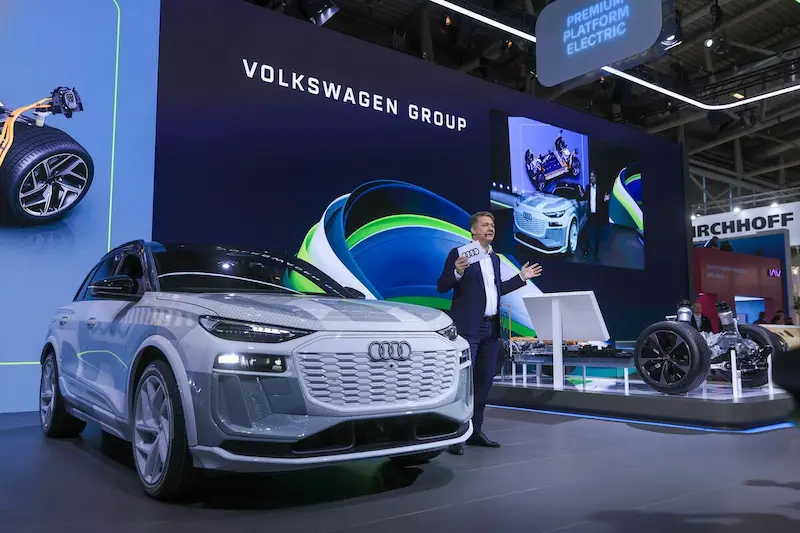


Audi has decided to scale back its ambitious plans for electric vehicle (EV) launches in order to alleviate pressure on its factories and dealerships amidst slower growth in EV sales. The luxury car manufacturer plans to release a total of 20 models by 2026, with half of them being fully electric. However, the company has decided to spread out the launches to avoid overwhelming its team and dealerships.
This decision comes as a response to the growing competition in the EV market. Rivals such as Mercedes-Benz and BMW are preparing to release their next generation of EVs by the mid-decade, putting pressure on Audi to keep up. Additionally, Audi has been facing some challenges recently, with VW CEO Oliver Blume expressing disappointment in the brand's performance. In June, Döllner was appointed as the new CEO of Audi, with the task of increasing the company's long-term operating return.
The launch of the Q6 e-tron, Audi's first electric model, has been repeatedly delayed due to issues at VW's in-house software unit, Cariad. The Q6 e-tron is now set to go into production in the second quarter of next year and will be the first vehicle built on a new platform that will underpin several upcoming models. Alongside the Q6 e-tron, Audi plans to launch another electric model and two combustion engine cars in 2022, with an additional combustion engine model planned for 2025.
Audi's challenges in the EV market are partly due to the hurdles faced by established automakers as they attempt to develop competitive EV lineups while maintaining profitability. Consumers are also deterred by high prices and a lack of charging infrastructure. Regulatory changes related to the phase-out of combustion engines and the rising popularity of attractive Chinese-made EVs further complicate the situation. With these factors in mind, Audi aims to position itself robustly and flexibly for the transition to electric mobility by offering a combination of EVs, plug-in hybrids, and traditional combustion engine models.
Revitalizing Audi is crucial for its parent company, Volkswagen, as its premium brands, including Audi and Porsche, generate the majority of the company's profits. This week, VW's top managers are convening in Berlin to discuss strategies to increase profitability for the underperforming VW brand and address challenges in the Chinese market, which is vital for VW's success.
Audi has faced difficulties in transitioning its lineup, which is heavily reliant on diesel engines, due to various obstacles such as a dealer dispute in China and the fallout from the diesel emissions scandal. In an effort to regain traction, particularly in the Chinese market, VW's CEO, Blume, has spearheaded initiatives to meet consumer demands for large screens and connectivity. To combat the decline in EV sales in China, Audi has partnered with Chinese automaker SAIC Motor Corp Ltd. to develop EVs and accelerate its electrification efforts.
Despite the challenges, Audi remains determined to establish itself as a significant player in both the combustion engine and EV segments. The company recognizes the gradual shift in consumer preferences and, with the support of its partners, aims to solidify its position in the EV market while continuing to cater to traditional combustion engine customers.