


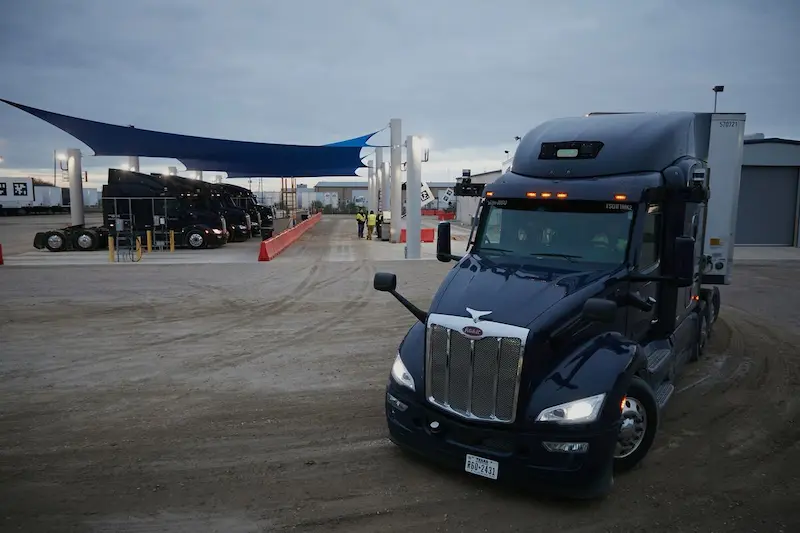


In a significant step towards revolutionizing the trucking industry, three startup firms are preparing to deploy driverless trucks on Texas highways. Aurora Innovation Inc., Kodiak Robotics Inc., and Gatik AI Inc. are confident in their technology and plan to remove safety drivers from their trucks, relying instead on advanced software and a range of sensors. Despite objections from critics, who claim that financial motives are driving the accelerated timeline, the companies have already provided services to major retailers such as Walmart, Kroger, FedEx, and Tyson Foods.
According to Chris Urmson, the CEO of Aurora, the plan is to start operating trucks without drivers on board by the end of this year. Although all the companies involved understand the need for careful execution due to the limited margin for error, they believe the potential benefits outweigh the risks. Improved safety on highways and reduced transportation costs are among the promises of this technology.
However, opponents argue that the startups are motivated by financial pressures to minimize the losses investors have incurred during the development and testing phase. Advocates for Highway and Auto Safety, headed by President Cathy Chase, express concerns over the lack of regulation, transparency, and comprehensive data collection. The International Brotherhood of Teamsters, a union representing drivers and warehouse workers, also opposes the deployment of driverless trucks.
Critics highlight the potential dangers posed by these massive vehicles, which can weigh up to 80,000 pounds and travel at highway speeds. In comparison, General Motors' Cruise driverless robotaxi weighs only a fraction of this. The federal government has largely left regulation of driverless trucks to the states, resulting in a patchwork of rules. California, for example, suspended autonomous vehicle operations after a series of incidents in San Francisco. Texas, with its more permissive regulations, has become a preferred testing and deployment destination for the three driverless truck firms and others.
The startups argue that trucks present fewer challenges compared to robotaxis on city streets. As trucks usually operate on fixed routes, primarily on highways, there is less need for interaction with pedestrians and passenger vehicles. Additionally, the use of advanced sensors allows for quicker identification of objects and faster reaction times. The technology also offers potential cost savings, as driverless trucks can travel for extended periods, beyond the 11-hour limit for human drivers. The companies estimate that emission reductions of around 10% are achievable by maintaining steady speeds just below the limit.
Human drivers have been involved in a significant number of fatal accidents, with over 5,700 large trucks being part of fatal crashes in 2021 alone. Most of these incidents involved trucks similar in size to those in the fleets of Kodiak and Aurora. While the testing of driverless trucks with safety drivers has not resulted in any at-fault incidents, the companies will rely heavily on data collected by the self-driving truck's computer system to determine the cause of any accidents.
Brian Ossenbeck, a transportation industry analyst, emphasizes that the bar is set high for the companies planning to deploy driverless trucks this year. They need to demonstrate a superhuman level of safety to earn broader acceptance. While the startups are confident about their technology, there is still uncertainty about the timeline for mass adoption.
Aurora, based in Pittsburgh, has set the end of 2024 as its goal for going fully driverless. Its success in achieving this target will be closely monitored by Wall Street. If delays occur, concerns about cash burn may dampen investor enthusiasm. The startup has secured $850 million in funding, sufficient to sustain operations until the second half of 2025. To continue its expansion plans through 2027, when a profit is projected, Aurora plans to raise a similar amount of capital.
Gatik AI, headquartered in Mountain View, California, has already conducted driverless truck operations in Arkansas and Canada using smaller box trucks. The company plans to deliver goods from distribution centers to stores and aims to deploy driverless trucks at scale in the Dallas area by 2024. Similarly, Kodiak, also based in Mountain View, will initially start small in 2024, gradually increasing operations near its truck terminal south of Dallas.
The limited regulations surrounding self-driving trucks have led to their initial introduction in southern states, where the weather conditions are generally milder. These states include Arizona and Florida, along with Texas. The Texas Department of Transportation acknowledges that autonomous vehicles can enhance safety, drive economic growth, and improve transportation experiences for all Texans.
However, both state and federal regulators retain the authority to halt operations and potentially force a recall if they deem the technology poses unreasonable risks to the public. The success of the first driverless runs in Texas will play a critical role in shaping the future of the trucking industry and the broader acceptance of autonomous vehicles.