




Chinese electric vehicle maker BYD Co. has announced plans to invest 100 billion yuan ($14 billion) in developing smart car features. The move comes as BYD aims to catch up with competitors who have already incorporated advanced driver-assistance systems and other cutting-edge technologies into their vehicles.
BYD's founder and CEO, Wang Chuanfu, did not provide specific details or a timeline for the investment. However, the company's goal is to narrow the gap with rival manufacturers by introducing what it calls Navigation on Autopilot. This feature will allow drivers to temporarily relinquish control of the wheel and pedals in certain scenarios. Drivers will still be required to touch the steering wheel every 15 seconds. The system will be available as a standard feature in cars priced over 300,000 yuan and as an upgrade option for vehicles priced over 200,000 yuan. It is unclear who would be considered liable in the event of a crash.
Advanced driver-assistance systems have become increasingly popular in China and other markets. Smart cars equipped with such features can operate on autopilot on select highways and in certain cities, as well as automate parking. Competitors like Xpeng Inc. and Huawei Technologies Co. have already integrated ADAS features into their vehicles to distinguish themselves and command higher prices.
Xpeng, in particular, has been recognized as a leader in smart driving technology, with its navigation-guided pilot system (XNGP) deployed in 52 cities across China. The system uses real-time data from Lidar sensors and cameras to enable automatic acceleration, braking, lane detection, and even traffic light detection. Xpeng vehicles also offer a memory parking feature, allowing the car to navigate through parking garages to a predetermined spot.
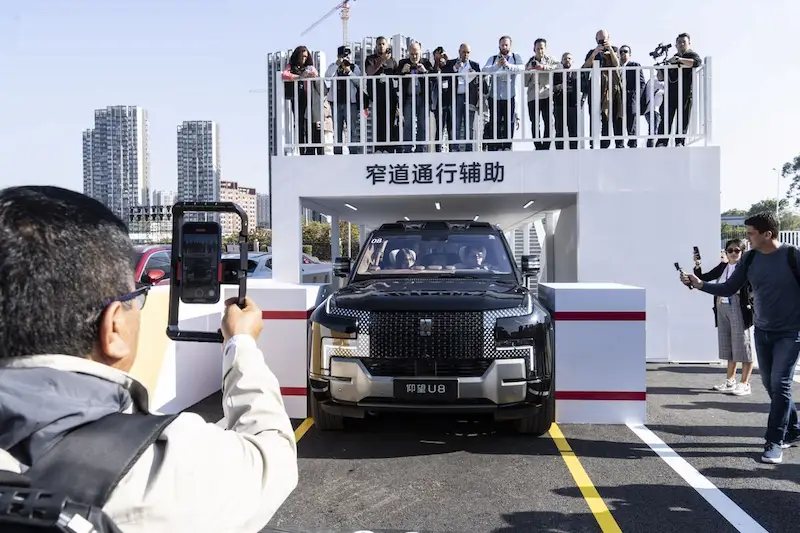
BYD has already equipped its Denza N7 EV with the Navigation on Autopilot feature and plans to introduce it to its luxury brand, Yangwang. It may also incorporate the technology into other mainstream models. Additionally, BYD revealed other non-driving features it is exploring to enhance the driver experience. For instance, the Yangwang U8, costing around 1 million yuan, will come with a vehicle-mounted drone and a special housing case. The steering wheel has been redesigned to detach from the control column, enabling drivers to use it and the car's pedals to play video games while stationary, such as car racing. Some higher-end models will also incorporate palm-print motion sensors to allow drivers to open doors by simply waving.
BYD also provided updates on its overseas expansion plans. The company confirmed that its Denza brand, in which Mercedes-Benz Group AG holds a 10% stake, will launch in Europe during the fourth quarter of this year. Additionally, BYD plans to export its Yangwang and Fang Cheng Bao brands. It is likely that these brands will be renamed to better suit international markets. In December 2020, exports accounted for approximately 11% of BYD's total sales.
In a further push to facilitate global exports of electric vehicles, BYD unveiled the first of eight cargo ships it will acquire over the next two years. These ships will help BYD transport its EVs around the world and expand its presence in international markets.