


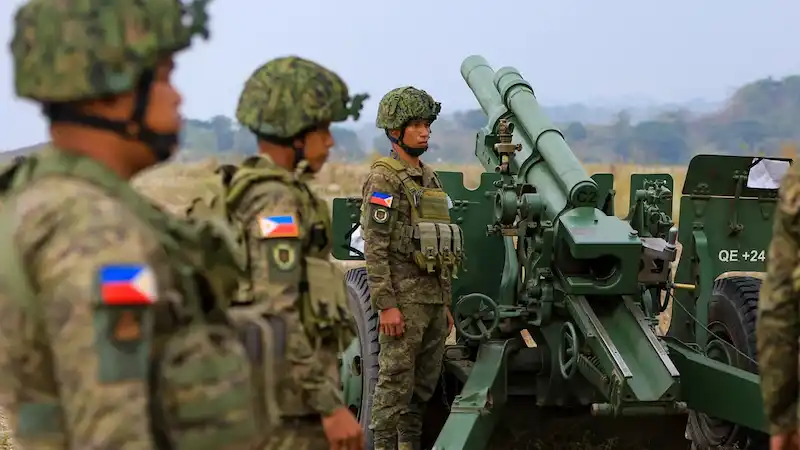


The United States and the Philippines conducted the annual Balikatan drills on Wednesday, which involved more than 17,600 military personnel – the largest such exercises ever conducted by the two countries. The exercise included a simulated attack on a decommissioned warship in the South China Sea, close to the island of Luzon. The exercise was watched live by Philippine President Ferdinand Marcos Jr. The US and Philippine military leaders said the exercise was designed to synchronize combat forces, increase realism and complexity, and strengthen their capabilities in full-spectrum military operations across all domains.
The Balikatan exercises come against a backdrop of warming relations between the two treaty allies following the election of Marcos Jr, who has sought to develop closer ties with Washington in the face of a more assertive China. The US and the Philippines have maintained a mutual defense treaty since 1951, but under Marcos’ predecessor Rodrigo Duterte, the Philippines tilted toward China, downplaying longstanding territorial disputes with Beijing while seeking to attract investment.
The Balikatan drills follow the announcement that the Philippines will grant increased access by US forces to bases in the archipelago under the 2014 Enhanced Defense Cooperation Arrangement (EDCA). The four bases joined five included earlier, including three on the main island of Luzon, close to Taiwan, and one on Balabac Island close to Chinese installations on the disputed islands in the South China Sea.
China claims “indisputable sovereignty” over almost all of the 1.3 million square mile South China Sea, including several islands claimed by the Philippines, despite a 2016 international tribunal ruling refuting its supposed “historical rights” of the area. Regional tensions in the South China Sea spiked in February, when the Philippines said a Chinese Coast Guard ship aimed a “military grade” laser at some of the crew of a Philippine Coast Guard vessel, temporarily blinding them.
Besides Tuesday’s exercise, this year’s Balikatan drills have also featured weaponry battle-tested by Ukrainian troops defending against Russian forces, including handheld Javelin anti-tank missiles and HIMARS rocket systems. Another key element has been the presence of US’ 3rd Marine Littoral Regiment, a new concept for Marine Corps warfighting designed with a conflict against China in mind.
The exercises have also included amphibious operations, maritime security, cyber defense, counterterrorism operations, as well as humanitarian assistance and disaster relief, according to a statement from the US Embassy in Manila. Meanwhile, in another sign of increasing US-Philippine military cooperation, the US Pacific Air Forces said on Tuesday that a key air exercise will return to the Philippines next month for the first time since 1990. Exercise Cope Thunder, to be held May 1 to 12, will feature US Air Force F-16 fighter jets deploying from Misawa Air Base in Japan and joining with Philippine Air Force units at Clark Air Base to “provide bilateral fighter training” and “improve combined interoperability.”