


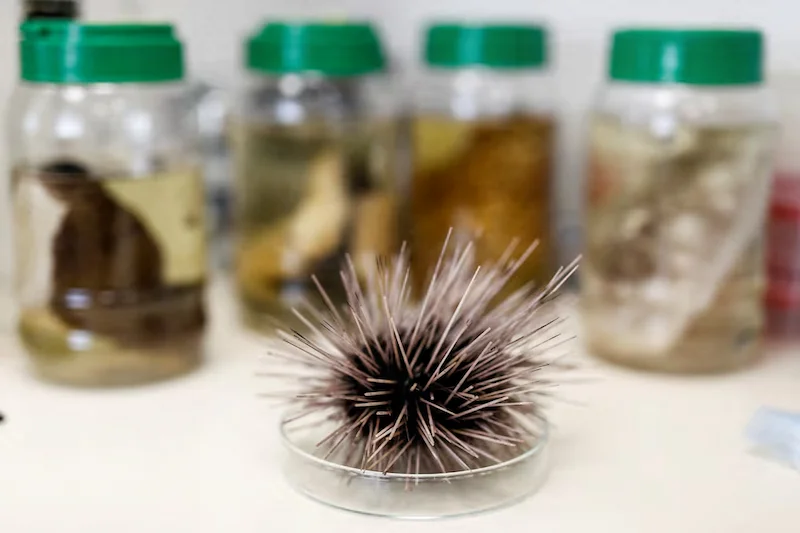


A deadly sea-borne pandemic that has decimated sea urchin populations in the Red Sea is now spreading, posing an imminent threat to parts of the Indian Ocean and potentially beyond, Israeli scientists warn. The event is endangering a particular species of sea urchin known for its vital role in protecting coral reefs, placing an already fragile marine ecosystem in even greater jeopardy.
The pandemic was first detected in the Gulf of Aqaba a year ago. Through meticulous molecular analysis, researchers have successfully identified the pathogen responsible for this devastating outbreak. Alarmingly, they have linked this lethal pathogen to widespread sea urchin mortalities not only throughout the Red Sea but also across the Arabian Peninsula and even reaching as far as Reunion Island off the coast of Madagascar.
According to Omri Bronstein, a zoologist affiliated with Tel Aviv University and the Steinhardt Museum of Natural History, the pathogen acts with shocking rapidity and brutality. Entire colonies of sea urchins can perish within a mere 48 hours, complicating efforts to quantify the extent of the devastation. "The situation is critical, and the pathogen's swift lethal action makes it nearly impossible to keep track of the number of deaths," said Bronstein.
The outbreak appears to be advancing eastward towards the biodiverse waters of the Coral Triangle, extending to Southeast Asia and Australia's iconic Great Barrier Reef. "Given the current trajectory, it's highly likely that the pathogen will continue to spread in this direction," Bronstein cautioned. These critical findings have been published in the scientific journal Current Biology.
Bronstein poetically describes the targeted sea urchin species as the "lawn mowers" of coral reefs. These urchins play an essential role in maintaining coral health by consuming algae that would otherwise proliferate and obstruct sunlight, crucial for coral survival. In the Gulf of Aqaba, no other organisms have stepped in to fulfill this role, resulting in an alarming increase in algae coverage.
"The outbreak in the Red Sea was characterized by such abrupt and intense mortality rates that initial assessments suggested pollution or some other severe yet localized cause," Bronstein explained. However, the pandemic soon appeared at a wharf in southern Sinai, where ferries from Aqaba dock. Alarmingly, the disease spread another 70 kilometers within just two weeks, leaving thousands of skeletal remains of once-thriving sea urchin colonies scattered across the sea floor.
Currently, there is no known method to halt the progression of this deadly disease. However, researchers believe there may still be an opportunity to create an isolated broodstock population of sea urchins. These could potentially be reintroduced at a later date to help restore devastated populations.
The Israeli research team is collaborating extensively with scientists across the region to meticulously map the pandemic's spread and gather essential data. This collaborative effort includes the continuous collection of environmental DNA samples from various bodies of water to better understand how sea life interacts with their environments. "On-site data collection is crucial," emphasized Bronstein. "Within 48 hours, all evidence of mortality events could disappear. Effective coordination and collaboration are key to staying ahead of this rapidly evolving situation."
As the pathogen continues its deadly march, the race to save these critical sea urchin populations—and by extension, the coral reefs they protect—has become more urgent than ever.