


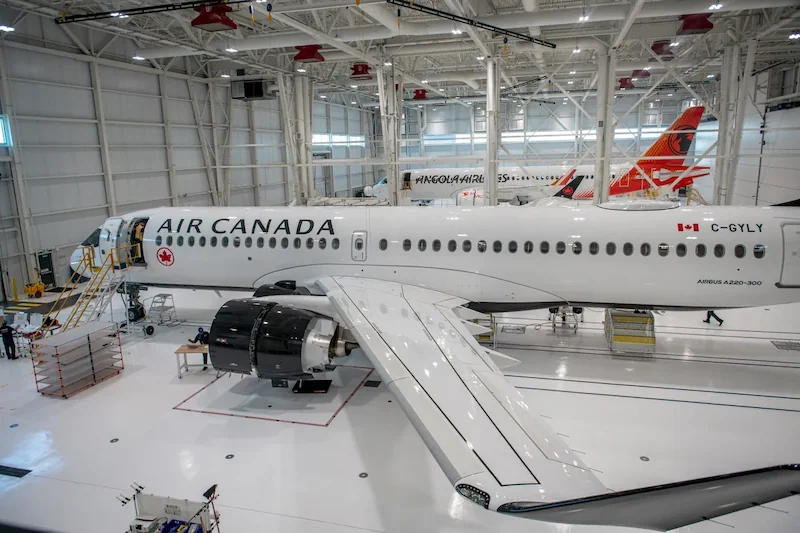


In aviation, timing is everything — not just when to take off, but when to take a gamble. At the moment, Airbus seems to be toeing that line with a proposal that has been floating around for years but never quite taken off: a stretched version of its A220-300, which insiders have already nicknamed the A220-500. It’s not official, not confirmed, not even finalized. But it’s definitely in the air.
The concept is straightforward in theory: more seats, less range. Pack more passengers into a longer fuselage, but don’t overhaul the wings or the engine. Keep it simple, and most importantly, keep it cheap — at least compared to a full-on redesign. That sounds like a reasonable compromise in a market starved of next-generation narrowbody aircraft. But aviation doesn’t run on compromise alone.
The A220, for all its sleek design and passenger comfort, hasn’t been the golden goose Airbus hoped for. The backlog has been thinning out. Sales dipped. Not a single fresh order landed this year — in fact, one was cancelled. It’s still not turning a profit. Yet, here comes the Paris Air Show, and with it, a chance to put the spotlight back on the A220 line. Reportedly, AirAsia might bite — talks are in motion for up to 100 units. That kind of number would not only resuscitate the aircraft’s reputation but breathe life into the idea of its big sibling.
The catch? Range. The stretched model wouldn’t be able to cross the U.S. from coast to coast — at least not without trade-offs. For airlines with transcontinental ambitions, that’s a dealbreaker. But in Europe, where routes are tighter and fuel efficiency often trumps reach, there’s interest. Airlines like Air France-KLM don’t need to fly New York to LA; they need to pack more passengers into short- and mid-haul flights across the continent. For them, the A220-500 — even in its more basic form — could be a sweet spot.
Airbus seems to prefer this simpler approach. No new wing. No larger engines. No massive engineering lift. It’s a quicker path to market, one that sidesteps the need for regulatory re-certification nightmares and the ballooning costs that come with a deeper redesign. After all, Pratt & Whitney’s GTF engine problems have already grounded hundreds of planes. The last thing anyone wants now is to complicate things further with a completely new powerplant.
It’s worth remembering that this isn’t a brand-new dream Airbus is chasing. Bombardier, the Canadian company that first built what we now call the A220, had already drawn up engineering studies for a stretched model before Airbus took the reins in 2018. Bombardier’s C-Series vision was always bigger than the first two models — they just never had the cash or market traction to realize it. Now Airbus, with its global reach and financial heft, could make it happen.
But don’t expect anything overnight. Even insiders are cautioning that Airbus is far from a final decision. The discussions are live, but timing remains fuzzy. Nothing is greenlit until the company says so — and so far, they’re staying noncommittal.
What’s clear, though, is that the market wants something. Boeing’s 737 Max and Airbus’s A320 lines are basically sold out for the next ten years. No one’s building a brand-new narrowbody yet, and airlines are looking for alternatives they can get their hands on sooner rather than later.