


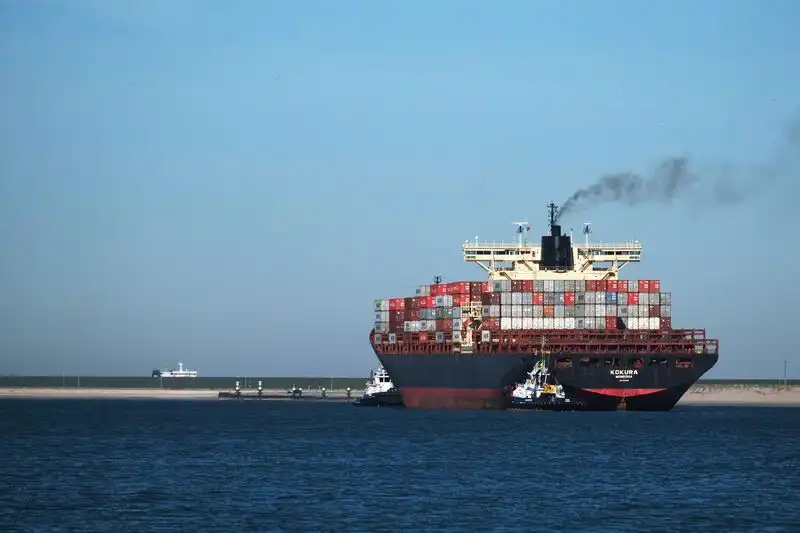


In a nondescript building situated by the Thames River in London, discussions have commenced on how to address the environmental impact of an industry that bears responsibility for over 80% of global trade. Shipping, although often overshadowed by attention on planes and cars, is a significant contributor to carbon dioxide emissions. In fact, it accounts for nearly 3% of manmade CO2 emissions. With the anticipated growth in seaborne trade until 2050, the industry's transition to cleaner energy sources becomes increasingly imperative.
Under the guidance of the International Maritime Organization (IMO), the global regulator, a series of international meetings is underway to outline eco-friendly objectives for the shipping industry and formulate a path towards achieving them. By the end of this week, a crucial new target is expected to be established, although the specific wording remains undecided. A draft document seen by Bloomberg News suggested that the industry aims to achieve net-zero emissions "around" 2050. This objective is not solely about the final target but also the emissions accumulated along the way, aligning with the Paris Agreement's objective of limiting global warming.
While the draft did include indicative checkpoints for 2030 and 2040, they fell short of the more ambitious proposals put forth by the US, UK, Canada, and several European Union countries. Nonetheless, even a net-zero emissions target by 2050 would represent progress, as the industry's current goal is only a 50% reduction by that time, falling short of Paris Agreement standards. However, the establishment of a target alone is insufficient without concrete action. To effectively reduce carbon emissions, the industry must ultimately decrease its reliance on oil-derived fuels. Potential solutions involve adopting low or zero-carbon alternatives such as green methanol, as well as designing ships for greater efficiency, harnessing wind power, and exploring carbon capture technologies.
Undertaking such a monumental transition is far from easy, given that the industry consumes hundreds of millions of tons of fuel annually. The mammoth challenge lies in effectively producing an equivalent quantity of alternative fuels, or potentially even more due to oil's high energy density, and ensuring their widespread availability. Additionally, ships must be capable of utilizing these new fuels.
One potential method to drive change is the implementation of a charge or levy on emissions. Over 20 countries supported this concept at a recent global finance summit in Paris. However, it is worth noting that China and the United States, the world's two largest economies, were not among the supporters. Other nations and industry players, including Trafigura Group and the International Chamber of Shipping, have previously endorsed a similar notion of a levy-based Fund and Reward system. However, it remains uncertain whether governments possess the desire to swiftly develop such radical measures that are necessary to make substantial progress.
Another approach under consideration involves curbing greenhouse gas emissions relative to energy usage on ships. European Union countries have proposed this measure, highlighting that it would offer shipping companies and fuel suppliers the predictability they require to invest in decarbonization.
While no final decisions are expected at the current IMO meeting, the organization must eventually take action to avoid becoming irrelevant as others move ahead. Some major shipping companies have already embarked on the journey towards sustainable practices. For instance, A.P. Moller-Maersk has ordered 25 vessels capable of running on green methanol, while CMA CGM expects to receive 24 bio-methanol-powered, e-methanol ready ships by 2027. In a significant development, the majority of ships ordered last year were equipped to operate on alternative fuels, including liquefied natural gas.
The European Union has also taken the lead in implementing its own regulations. Starting next year, shipping will be included in the EU's emissions trading scheme, and the FuelEU Maritime regulation has been introduced to ensure reductions in greenhouse gas emissions relative to energy use.
If other countries follow in the EU's footsteps and establish their own requirements, the shipping industry may face a fragmented regulatory landscape, posing challenges for a globally interconnected sector.
This conundrum lies at the heart of the ongoing IMO talks. While the organization possesses the authority to institute comprehensive and uniform regulations to tackle shipping emissions, reaching a consensus among diverse member states with conflicting interests presents a considerable challenge.
Nonetheless, Secretary-General Kitack Lim affirmed last week that the time has come to find a solution, asserting that "2023 is IMO's year of decisive climate action."