


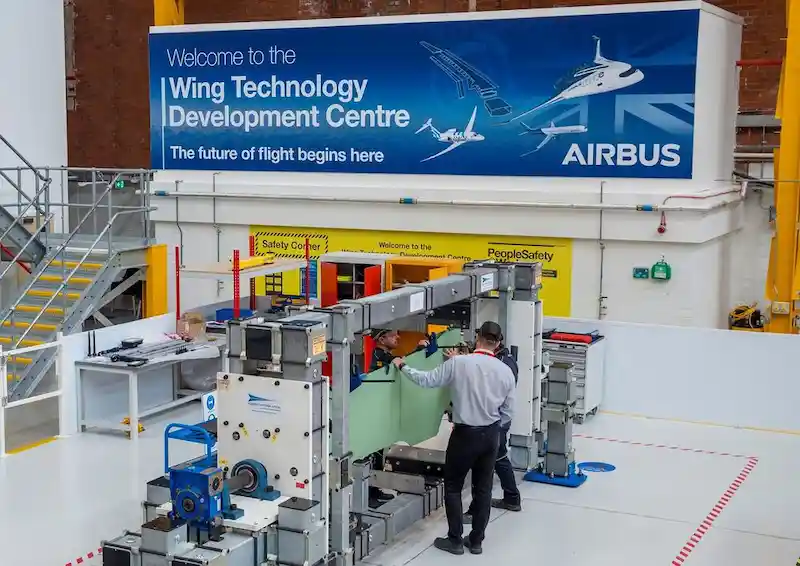


Airbus is currently developing an extended carbon-composite wing with foldable tips that could be incorporated into its future airliner models. The European aircraft manufacturer aims to achieve greater fuel efficiency and reduce its environmental impact with this innovative wing design. Sue Partridge, head of Airbus’s Wing of Tomorrow program, states that they are aiming to achieve similar efficiency gains from the wing design as they expect to derive from future advanced engines.
The proposed longer and more slender wings are a part of Airbus’s roadmap for their next-generation aircraft, which is set to enter the market in the mid-2020s. The current best-selling narrowbody aircraft from Airbus and Boeing are based on older designs and have mainly relied on engine upgrades to sustain their sales. However, now manufacturers are exploring more radical concepts and materials to enhance fuel efficiency for their future models, even though these aircraft are still more than a decade away from commercial service.
Partridge explains that this presents an opportunity for experimentation and the exploration of multiple options to determine the best wing design. Nevertheless, a key challenge remains in producing these new wings on a large scale and at a relatively low cost due to the high number of single-aisle aircraft that will require them. The widebody A350 already incorporates composite-material wings, but narrowbody aircraft are produced in much larger quantities.
The wing production process is highly complex, and Airbus currently concentrates its wing manufacturing operations in the UK. From there, the wings are transported by Beluga transport aircraft or barge to final assembly lines worldwide. Notably, Boeing has also hinted at a radical wing design called the Transonic Truss-Braced Wing concept, or TTBW, in collaboration with NASA. This concept features extra-long and super-thin wings with stabilizing struts that spread over the top of the fuselage.
Partridge envisions incorporating foldable wing tips, similar to those on the upcoming Boeing 777X, into the new Airbus wing design. These folding tips would allow for longer wings without compromising operations within existing airport infrastructure. The Boeing 777X's 11-foot tips are raised using an actuation system, enabling the aircraft to fit within the wingspan limits on the ground.
Airbus has gained significant expertise in composite wings through its A350 program, utilizing carbon-fiber structures that are produced in massive ovens and are among the largest in existence. However, the production rates and stress cycles for narrowbody aircraft are higher than for larger models, introducing additional challenges in the manufacturing process.
Airbus CEO Guillaume Faury has been actively discussing plans for the company's next-generation single-aisle aircraft, which are expected to enter service between 2035 and 2040 with a 20-25% improvement in fuel efficiency. In addition to innovative wing designs, the program may include the use of open-rotor engines currently being developed by the CFM International consortium.