




As the world experiences more frequent and extreme heat waves due to climate change, the consequences for human health are becoming increasingly apparent. While the immediate effects of heat on well-being are well understood, a new study has revealed a more insidious secondary effect: hunger. According to the study conducted by Carolin Kroeger, a doctoral researcher at the University of Oxford, households around the world struggle to afford food during periods of extreme heat that make it too difficult to work and earn an income. This research, published in the journal Nature Human Behaviour, sheds light on the profound impact that rising temperatures have on food security.
Kroeger's study found that a week of hot temperatures, defined as a week with at least three days ranking in the hottest 10% of the year, was correlated with a small but significant increase in household food insecurity. If this trend were to be extrapolated to a country like India, for instance, it would mean an additional 8 million people struggling to feed themselves properly during a week of extreme heat. The reason behind this correlation lies in the fact that as temperatures soar, people whose income relies on their productivity may earn less. This can either be because they choose to forgo work or because the heat impairs their ability to perform at their usual productivity levels. In 2021 alone, extreme heat resulted in the loss of 470 billion work hours globally, roughly equivalent to 1.5 weeks of work per person.
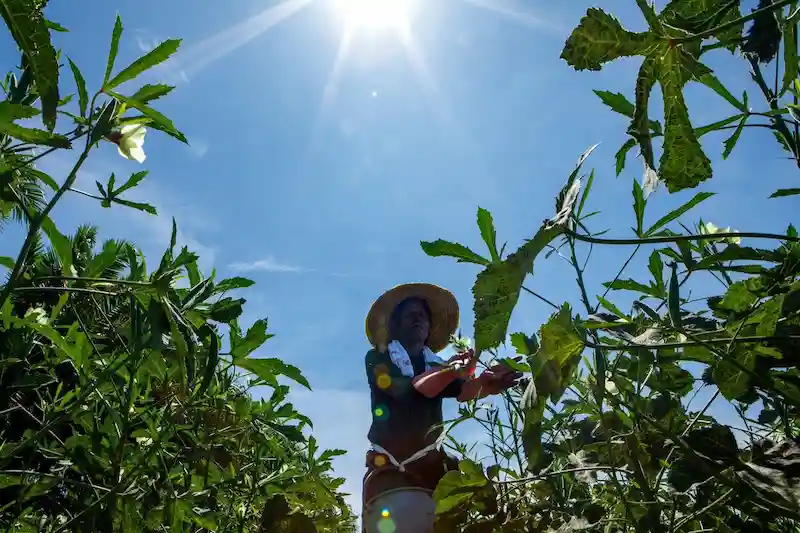
The impact of heat on workers' earnings is particularly significant for those in informal, precarious outdoor employment. Day laborers, agricultural workers, and individuals with informal employment are more vulnerable and less likely to have a safety net. Furthermore, in the United States, many agricultural workers are undocumented, which limits their access to social services. Textile factories, known for their poor insulation, ventilation, and lack of air conditioning, also pose a challenge for indoor workers. Moreover, the lack of access to refrigeration exacerbates the food insecurity issue in many areas.
While this study does not establish a causal relationship between increased heat and food insecurity, the correlation between precarious outdoor employment and food insecurity is logically coherent. Antonella Mazzone, a researcher at the University of Bristol, commended the study as a crucial wake-up call regarding the intersection of climate change and food security. Mazzone emphasizes the need for prompt intervention and mitigation strategies to address these circumstances.
To arrive at her conclusions, Kroeger analyzed over half a million observations from the Gallup World Poll, which surveys adults across almost every country. Using temperature data from the Universal Thermal Climate Index, she compared responses from those who experienced a hot week to those who did not. The results showed that individuals experiencing a hot week were more likely to face food insecurity during that period. Additionally, the number of hot days experienced was directly correlated with higher rates of food insecurity.
In order to mitigate the effects of extreme heat on food security, strengthening social networks and improving access to refrigeration are crucial steps. Additionally, exploring innovative solutions such as microinsurance programs, like the Rockefeller Foundation pilot in India, can provide financial support to informal workers during extreme heat, allowing them to refrain from working in hazardous conditions without sacrificing their income. Long-term solutions will require designing cities, workplaces, and buildings that prioritize passive cooling mechanisms to ensure the well-being of workers, preventing them from having to choose between their health and hunger.
As the global climate continues to warm, addressing worker safety and the associated risks of food insecurity must be a top priority. It is crucial for governments, policymakers, and individuals to come together to implement sustainable and comprehensive solutions that alleviate the impact of heat waves on food security.