


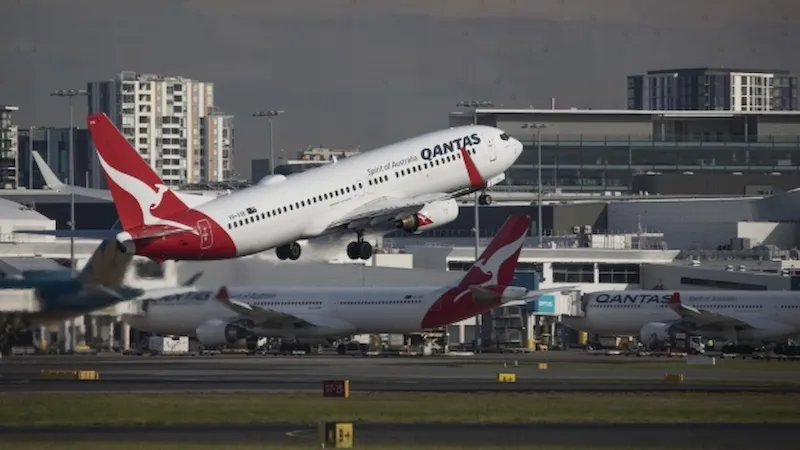


Qantas Airways Ltd. and Air New Zealand Ltd. have recently made significant purchases of new aircraft, further reinforcing their commitment to meet the growing demand for air travel. Despite concerns about high ticket prices, both airlines are optimistic about the lucrative post-Covid travel boom.
Qantas, Australia's national carrier, announced the acquisition of 12 Boeing Co. 787s and 12 Airbus SE A350s to replace their aging Airbus A330 fleet, which primarily operates flights to Asia and the US. The airline also holds options to purchase additional aircraft over the next decade.
In Auckland, Air New Zealand revealed their plans to purchase two ATR72s and two Airbus A321s. The ATR72s, which have a seating capacity of 68, will cater to short domestic routes, while the Airbus A321s can transport over 200 passengers on flights to Australia and the Pacific Islands.
Both airlines are capitalizing on their return to profitability following the pandemic, with the airlines' earnings being underpinned by strong travel demand and limited seat availability. This has resulted in soaring ticket prices and a growing need for more aircraft.
This trend is not limited to Qantas and Air New Zealand; airlines worldwide are grappling with a similar situation. Airlines such as IndiGo in India and Ryanair in Europe are making airplane orders that extend well into the next decade due to the high demand for international travel coupled with a scarcity of new aircraft.
Qantas CEO Alan Joyce emphasized the robustness of travel demand, stating that the airline can afford to invest and expand its fleet, particularly with new aircraft. However, securing new aircraft is becoming increasingly challenging due to long waiting times for popular models manufactured by Boeing and Airbus.
For Qantas, this recent order marks their third major aircraft purchase in less than two years. The airline previously announced a multibillion-dollar deal with Airbus to replace its short-range Boeing domestic aircraft, followed by an order for a dozen ultra-long-range Airbus A350-1000s for direct flights between Australia's east coast and destinations like New York and London.
Air New Zealand's new aircraft acquisition brings their total order to 16, including eight Boeing 787 Dreamliners, six Airbus A321s, and two ATR72s, all scheduled for delivery between 2024 and 2028.
While the additional capacity provided by these new planes may help alleviate pressure on fares, Air New Zealand CEO Greg Foran believes that a return to pre-pandemic ticket prices is unlikely. He stated that flying continues to be in high demand, resulting in higher-than-usual prices. Additionally, the airline faces rising costs in various areas that prevent airfares from reverting to pre-Covid levels.
Amidst this aircraft expansion, Auckland Airport, New Zealand's main gateway, reported its first underlying profit and dividend in three years. The airport noted a significant increase in passenger numbers, with a 183% rise to 15.9 million in the 12 months ending in June. Trans-Tasman capacity has already reached 96% of pre-pandemic levels, and flights between Auckland and North America are projected to surpass 2019 levels during the southern hemisphere's summer season.