


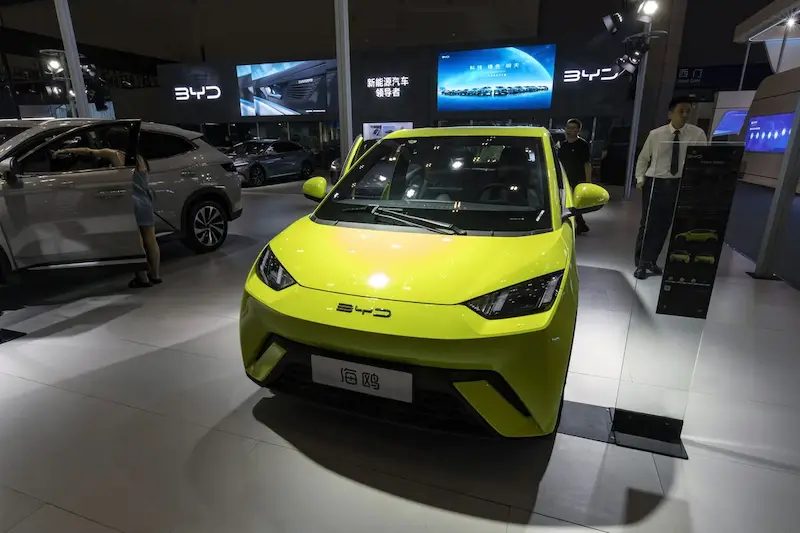


China's demand for electric vehicles has propelled indigenous automakers to establish a commanding lead over foreign competitors in the world's largest auto market. According to data from the China Automotive Technology and Research Center, domestic companies, led by BYD Co. and Geely Automobile Holdings Ltd., captured over 50% of total auto sales in July, marking a significant milestone.
This surge in market share has come at the expense of traditional German, American, and Japanese automakers such as Volkswagen AG, Ford Motor Co., and Toyota Motor Corp. UBS AG analysts have even warned that Western carmakers could potentially lose up to 20% of their global market share due to the rise of more affordable Chinese electric vehicles (EVs).
As Chinese consumers increasingly favor domestic brands, foreign manufacturers have been forced to retreat. Hyundai Motor Co. of South Korea, for example, is selling production facilities, Ford has made job cuts, and Stellantis NV closed down its only Jeep factory in China last year. Mazda Motor Corp.'s CEO, Masahiro Moro, has expressed concerns about the trends in China's auto market, noting the potential negative impact on sales and earnings.
Among the domestic automakers, BYD holds a significant 11% share of China's auto market. Its strategy of offering a wide range of EVs at various price points has contributed to its rapid growth. Currently, eleven out of the top 20 best-selling brands in China are from local companies.
Meanwhile, the market share of American brands, including Buick, Ford, and Chevrolet, has hit the lowest point since data tracking began in 2008. Without the presence of Tesla Inc., which opened a factory in Shanghai in 2019, the situation would be even more dire. Although German brands are performing slightly better, there are signs of vulnerability. Volkswagen lost its position as China's top-selling car brand to BYD earlier this year due to a lack of electric models. Even Mercedes-Benz Group AG has been embroiled in the country's intense price war.
In an effort to regain ground, Volkswagen recently struck a $700 million deal to acquire a 5% stake in Xpeng Inc., an EV startup facing financial losses. As part of the agreement, Volkswagen will produce at least two new electric models specifically for the Chinese market under its own brand.
French automakers have experienced a significant decline in popularity, with Citroën, Peugeot, and Renault all holding less than 1% of the market share. Stellantis CEO Carlos Tavares is adjusting the company's strategy in China, opting to exit certain factories and rely more on partnerships. This will result in an asset-light business model that is less of a financial burden.
Overall, China's indigenous automakers have gained a formidable advantage in their home market, driven by the growing demand for electric vehicles. With the support of favorable policies and a wide range of offerings, Chinese companies have solidified their position while foreign manufacturers face significant challenges in maintaining their market share.