


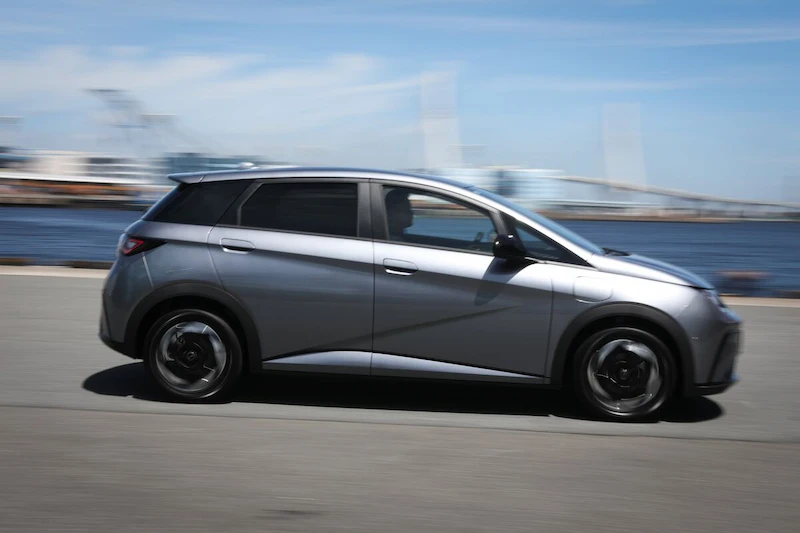


Chinese automaker BYD is making a bold move by introducing its Dolphin electric car to the Japanese market. The compact hatchback is aimed at spearheading sales in a market that has been hesitant to embrace Chinese automakers and electric vehicles. With a starting price of ¥3.63 million ($24,560), the Dolphin is equipped with a 70 kilowatt hour battery that offers a range of 400 kilometers (250 miles). There is also an extended-range model available, priced at ¥4 million, which comes with a 150 kWh battery that offers an impressive 476 kilometers per charge.
Despite being China's largest automaker and a frontrunner in the EV industry, BYD has struggled to make a significant impact in Japan, where consumers prefer domestic powerhouses like Toyota, Honda, and Nissan. Imported cars, especially luxury models, only account for about 6% of the Japanese market. However, BYD is determined to change this trend and hopes to sell 1,100 units of the Dolphin in Japan by March 2024. As part of its efforts, BYD plans to showcase its vehicles at the upcoming Japan Mobility Show in October.
BYD had previously introduced its Atto 3 electric SUV to the Japanese market earlier this year but faced challenges competing with Nissan's popular electric vehicle, the Leaf. The Atto 3, priced from ¥4.4 million, has only managed to sell around 700 units since its launch. In comparison, Nissan's mini Sakura, priced just over ¥2.5 million, remains the top-selling EV in Japan.
The Japanese market still heavily favors hybrids over pure battery EVs, with Toyota being slow to transition to EVs. BYD, however, sees great potential in Japan and plans to open 100 dealerships and showrooms by 2025. The company also intends to launch its Seal sedan in Japan early next year, further expanding its product offerings in the country.
Entering Japan's auto market, the third-largest in the world, provides BYD with a significant growth opportunity as Chinese automakers face increasing hostility in Europe and the US. The European Union, for example, has initiated an investigation into Chinese EV subsidies to protect its own automakers from cheap imports. While BYD has expanded its presence in other regions such as Southeast Asia, South America, and Australia, it has so far stayed out of the US market due to specific requirements, such as the manufacturing location of EVs for eligibility for government tax credits.
Analysts see this move into Japan as a chance for BYD to tap into an untapped niche market. The Dolphin is expected to do well in Japan due to the improving quality of BYD's vehicles and a decreased bias against Chinese products among Japanese customers. In terms of charging infrastructure, the Dolphin will use the CHAdeMO system, which was developed in 2010 by a consortium that includes Toyota and Tokyo Electric Power Co. Although CHAdeMO-equipped vehicles have become a minority, BYD and Tesla have established their charging systems as the standard in major markets.