


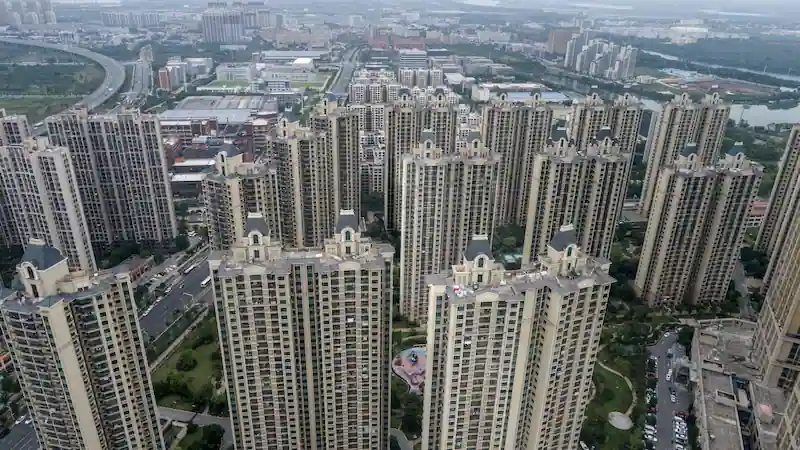


China's once booming property market, which accounted for up to 30% of the country's economy, has been in crisis for over two years. This downturn, triggered by a government crackdown on developer borrowing, has led to a decline in real estate investment for the first time in a decade. With no immediate bailout in sight from Beijing, the property market's downturn is expected to continue and pose a significant threat to China's growth prospects over the next few years.
Alicia Garcia-Herrero, Chief Economist for Asia Pacific at Natixis, states that the only way for China to recover from this crisis is through a slow and painful adjustment. The country needs to match the supply of housing with the declining demand, as the population ages and the need for new homes decreases. However, achieving this balance will take time, potentially years, to conclude.
The Chinese government has implemented a nationwide "de-stocking" policy to reduce oversupply, including slowing down land sales in cities and encouraging developers to lower housing prices to stimulate demand. While these measures aim to absorb the excess capacity in the property sector, the adjustment process is expected to negatively impact China's economic growth. Garcia-Herrero predicts that China could witness an annual decline of around 1.5 percentage points in growth until at least 2026.
The World Bank recently downgraded China's GDP forecast for 2024 to 4.4% from 4.8%. The downgrade is attributed to persistent domestic challenges such as high debt levels, weakness in the property market, and an aging population. The International Monetary Fund (IMF) also expects China's growth to slow in the medium term, projecting a growth rate of around 3.5% due to demographic headwinds and slowing productivity growth. Such rates have not been witnessed since the late 1980s.
The property crisis in China is a result of years of developers following a business model of selling apartments before they are completed. This model, introduced in 1994 to meet high demand during rapid urbanization, allowed developers to finance their rapid expansion by selling properties in advance. However, the government's crackdown on excessive borrowing and rising debt levels prompted the cash crunch experienced by developers like Evergrande, which defaulted on its debt obligations in December 2021.
Evergrande's troubles have deepened with the recent detention of its founder and chairman, Xu Jiayin, on suspicion of crimes. With more than $300 billion in unpaid debts and numerous unfinished apartments, the fate of Evergrande poses a significant risk to the real estate market, household confidence, and broader economic stability. Other major developers, such as Sunac China, are also grappling with offshore debt restructuring plans.
As the property sector contracts due to a collapse in demand, the Chinese government is exploring alternative engines of growth. President Xi Jinping has emphasized the need to promote a "new type of industrialization," with a focus on sectors like green technology. However, analysts believe that these sectors, while experiencing rapid growth, are not substantial enough to compensate for the role played by the property market. Advanced manufacturing sectors alone are unlikely to generate the same growth, jobs, or impact on GDP.
Consumption also faces challenges as a replacement for the property sector's economic contribution. The negative wealth effect resulting from falling home prices has led to a decline in consumer confidence and a tendency to hoard cash. Household savings have surged, surpassing China's GDP, as people become more cautious about spending. Furthermore, the contracting property market and stock market have resulted in a decline in net household wealth for the first time in two decades.
The challenges facing Chinese policymakers include the need to create alternative avenues of income growth, enhance the social security system, boost disposable incomes, and improve productivity. Chinese households have limited capacity to borrow for consumption, with a significant portion of their income already tied up in housing-related debts. Structural policy changes, a focus on developing new industries, improving productivity, and bolstering rental markets are essential for China's economic transformation.
As China grapples with a prolonged property crisis, the road to economic recovery will be challenging. The significance of the property market for household wealth, local government income, and overall economic growth cannot be easily replaced. The government's efforts to reduce oversupply and stimulate demand, coupled with a focus on alternative engines of growth, will shape China's future economic landscape. However, the pain of adjustment will persist, potentially impacting economic growth for years to come.