


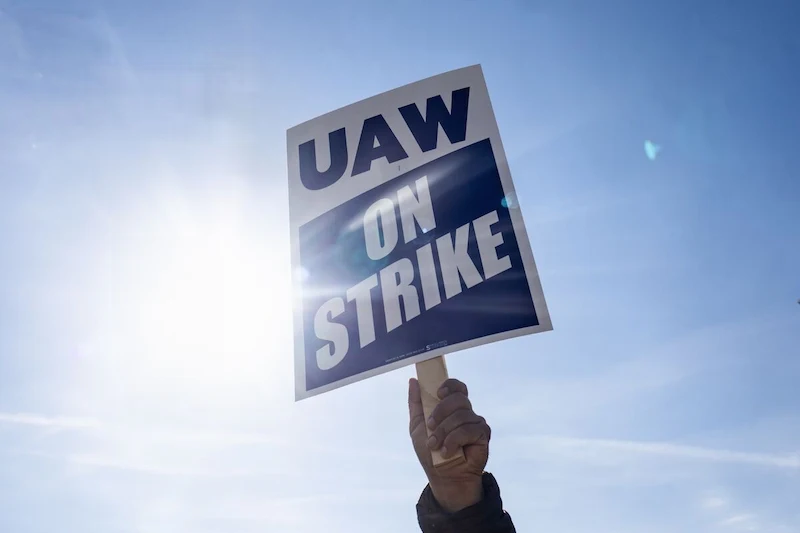


Ford Motor Co. and the United Auto Workers (UAW) have reached a tentative labor agreement, marking a significant step towards ending the prolonged strike that has impacted the automotive industry. While the UAW has yet to settle with General Motors and Stellantis, Ford's agreement puts pressure on its rivals to follow suit.
Under the terms of the deal, Ford has agreed to a record 25% hourly wage increase over the span of the contract, which extends beyond four years. When factoring in cost-of-living allowances, the top wage rate is expected to rise by 33%, amounting to over $40 per hour. This wage increase surpasses the union's initial demands and is likely to be well-received by the UAW membership.
Ford, which has the largest UAW workforce among Detroit's "Big Three" automakers, was the first company to present a counter-proposal to the union and has now become the first to resolve the dispute. The UAW leadership is scheduled to vote on the agreement on October 29, followed by the ratification process involving Ford's 57,000 hourly workers, which may take several weeks.
While the exact financial implications for Ford remain unclear, Ryan Brinkman, an analyst at JPMorgan Chase & Co., estimates that the agreement will add approximately $1.5 billion in annual costs for the automaker over the duration of the contract.
Following the announcement of the tentative agreement, Ford's shares saw a 2.3% increase to $11.80, bringing its year-to-date growth to about 7%. Later today, Ford's Chief Executive Officer Jim Farley is expected to discuss the provisional accord with the UAW during an analysts' conference call after the company's third quarter earnings report.
The negotiation process predominantly revolved around pay-related matters, with the union initially demanding a 40% raise and a 32-hour work week before revising its requests. Additionally, Ford agreed to cost-of-living allowances, the conversion of temporary hires to full-time positions, and streamlining the time it takes for workers to reach the top wage rate.
In a statement, President Joe Biden congratulated Ford and the UAW on reaching an agreement, emphasizing the importance of worker empowerment. However, key details concerning wages and benefits at battery plants and the union's demand for a 32-hour work week have yet to be disclosed.
UAW President Shawn Fain expressed satisfaction with the agreement, stating, "We won things nobody thought was possible." However, it remains uncertain whether the tentative deal includes provisions for Ford's battery plants or facilitates the UAW's organization of the new electric truck assembly plant in Tennessee.
Ford has been seeking manufacturing flexibility amid its transition to electric vehicles (EVs), as EV sales growth has slowed. The company recently adjusted its production plans for EVs and reduced prices for its F-150 Lightning plug-in pickup following customer concerns over high costs.
As Ford resolves its labor dispute, attention now turns to General Motors and Stellantis. The UAW is hopeful that the two companies will agree to similar terms in their upcoming negotiations. The union has urged Ford workers to return to work during the ratification process in order to apply pressure on the remaining automakers.
The strike, which commenced on September 15, initially impacted one assembly plant at each of Detroit's three automakers. Within six weeks, the strike expanded to encompass more than 45,000 workers across eight assembly plants and 38 parts-distribution facilities. In an effort to maintain unpredictability, UAW President Shawn Fain implemented surprise strikes, indicating that a larger strike was imminent if Ford failed to reach an agreement. The strike has resulted in an estimated $2.1 billion loss in earnings before interest and taxes for GM, Ford, and Stellantis as of October 23. GM, as a result, withdrew its earnings guidance due to uncertainty caused by the strike.