


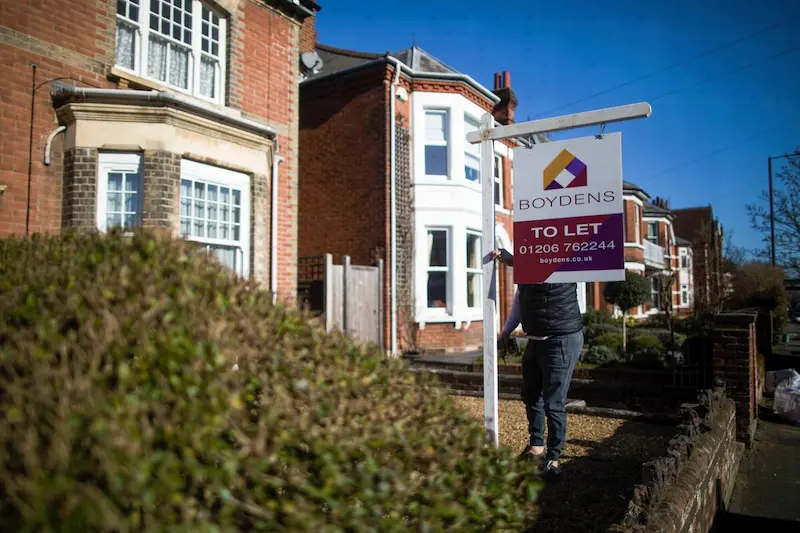


UK landlords are feeling the squeeze as rising rents fail to offset growing costs, resulting in them selling off buy-to-let properties at a higher rate than they are purchasing. According to a report by estate agents firm Hamptons, landlords are expected to sell an estimated 27,520 rental properties in 2023, marking the eighth consecutive year of portfolio downsizing. While this is a decrease from last year's loss of 47,250 rental homes, it highlights the ongoing trend of landlords reducing their portfolios due to stricter policies and increased expenses, including higher mortgage rates.
The UK rental market has witnessed a significant drop in available properties, with a 43% decrease during the first ten months of this year compared to the same period in 2015, according to Hamptons. Rent prices in London have skyrocketed, rising by 16% year-on-year in September. However, many landlords are still struggling to cover the mounting expenses associated with property ownership.
Landlords who have opted for interest-only mortgages, which are common in the UK, have been hit particularly hard by the rapid rate hikes enforced by the Bank of England. Consequently, the number of landlords with late mortgage payments has doubled in Q3 compared to the same period last year. For many landlords, this increase has tipped the scales in favor of selling their properties, leading to a scarcity of available rental units for tenants.
David Edward, a landlord with multiple properties, plans to sell his lowest-yielding property next year to pay down his other mortgages, even if it means displacing a longstanding tenant. With buy-to-let mortgages typically lasting two to five years in the UK, Edward has been hit hard by higher interest rates and expects to barely break even on his 14 properties over the next two years. The interest he pays on four loans has quadrupled since last year, and the rates on six more loans are set to double next year.
Aneisha Beveridge, head of research at Hamptons, describes the situation as a "structural scarcity of rental properties." Rising rates are making mortgage payments unaffordable for many landlords, forcing them to bow out of the market. Landlords are facing a 40% increase in mortgage interest payments compared to the previous year, according to Hamptons. The situation is worsening, with many landlords falling behind on their mortgage payments, and an increasing number of tenanted properties being auctioned.
However, landlords are not the only ones feeling the impact of higher rates. Elevated borrowing costs have also pushed down home prices in the UK, making it difficult for many people to buy properties. In October, UK home prices were down 4.7% compared to the previous year, and the number of agreed home deals reached its lowest level in four years, according to Zoopla.
While the hike in mortgage rates is a significant factor driving landlords to sell, other policy changes are also contributing to their decision. This includes the phasing-out of tax relief on mortgage payments by 2021, potential penalties on energy-inefficient properties, and the impending end of no-fault evictions. The possibility of a Labour government, known for its strict stance on landlords, has further added to the uncertainty.
For landlords like Dawn Jones and Nobby Clark, selling their properties has become an appealing option. Jones, who has experienced a costly eviction process, realizes that rents on her units are not keeping pace with mortgage costs and that she lacks sufficient protection against non-paying tenants. Clark, tired of dealing with tenants and concerned about stricter regulations, is selling his £1.1 million three-bedroom apartment in south London to invest the funds in more liquid markets.
In conclusion, UK landlords are facing a challenging environment due to rising costs and stricter policies. As a result, many are selling off their rental properties, which not only exacerbates the scarcity of available units but also reflects a broader trend of downsizing portfolios. With mortgage rates on the rise and other regulatory changes on the horizon, being a landlord in the UK is currently a challenging prospect.