


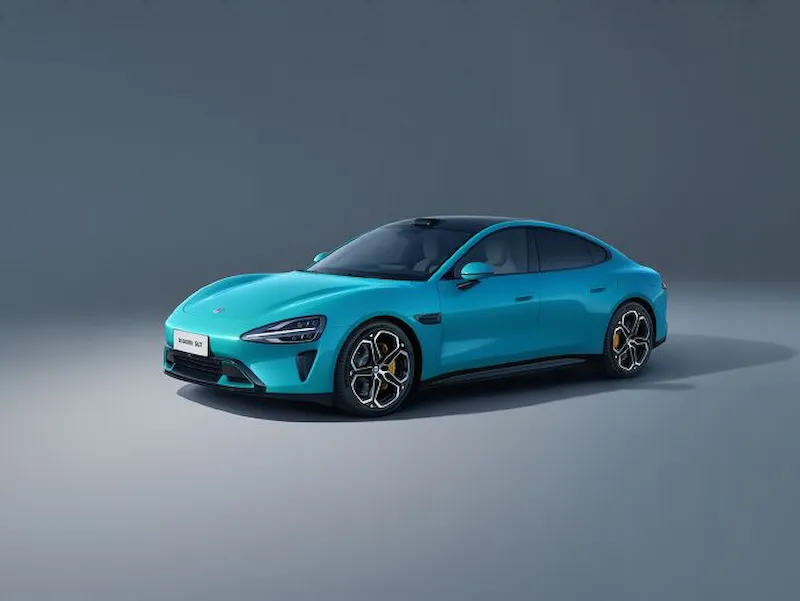


Chinese tech giant Xiaomi has officially unveiled its first electric vehicle (EV), the SU7, with CEO and co-founder Lei Jun announcing the company's ambitions to compete with industry giants such as Tesla and Porsche. The SU7, standing for Speed Ultra, made its debut at a launch event in Beijing, impressing the crowd with its futuristic features. Lei emphasized that Xiaomi's goal is to create a dream car that can match the performance and technology of renowned brands like Porsche and Tesla.
The SU7 boasts an impressive range of up to 800 kilometers (500 miles) on a single charge, adjustable spoilers, eye-catching colors, and a top speed of 265 kilometers per hour. Depending on the motor configuration, the five-seat sedan will be powered by batteries from leading Chinese companies Contemporary Amperex Technology (CATL) and BYD. Xiaomi's entry into the electric vehicle market is a bold move by Lei, who believes his company can disrupt the sector just as it did with smartphones a decade ago. He has referred to this venture as his final entrepreneurial bet.
However, Xiaomi faces challenges in the increasingly competitive and heavily regulated Chinese market. The Beijing government has limited manufacturing permits for new entrants, compelling Xiaomi to partner with state-owned Beijing Automotive Group for production. Additionally, government subsidies for electric vehicle purchases, which previously provided up to 60,000 yuan ($8,440) in reimbursement to consumers, ended in 2022. With hundreds of models from various brands already saturating the market, the SU7 will need to stand out to capture consumer attention.
Lei has set ambitious goals for the SU7, aiming to rival Porsche's Taycan Turbo in terms of performance and Tesla's Model S in terms of technology features. While the exact pricing for the SU7 has not been disclosed, Lei dismissed suggestions that it would be as low as 99,000 yuan, stating that cars with similar specifications typically cost around 400,000 yuan or more. Tesla's Model S starts at 698,900 yuan, and the Taycan Turbo begins at 898,000 yuan.
Tesla has faced challenges in the Chinese market, selling fewer than 200 Model S cars since its relaunch in 2023. In contrast, Porsche has delivered approximately 3,600 units of the Taycan family of EVs in China during the same period. Xiaomi plans to launch the SU7 in the market next year, boasting an impressive 0 to 100 kph acceleration time of 2.78 seconds. The vehicle's motor can reach a remarkable 21,000 revolutions per minute, surpassing the Model S and Taycan Turbo. Xiaomi's factory employs gigacasting manufacturing techniques pioneered by Tesla, implementing a 9,100-ton system known as hypercasting.
Xiaomi, historically known for its budget smartphones, aims to sustain growth by diversifying into the EV market. The company has faced declining sales in recent quarters, prompting its foray into the competitive automotive industry. Xiaomi will not rely on undercutting competitors to gain traction, positioning the SU7 as a high-performance vehicle for individuals who value technology, performance, and aesthetics.
Lei Jun has expressed admiration for other players in the EV industry, including BYD, XPeng, Li Auto, and Huawei, acknowledging their role in driving China's new energy vehicle sector forward. XPeng's CEO, He Xiaopeng, welcomed Xiaomi into the automotive family and extended best wishes for successful sales in 2024. Following the unveiling of the SU7, Xiaomi's stock initially rose but later fell by 0.3% on Thursday afternoon, following a 4.1% increase the day before.