


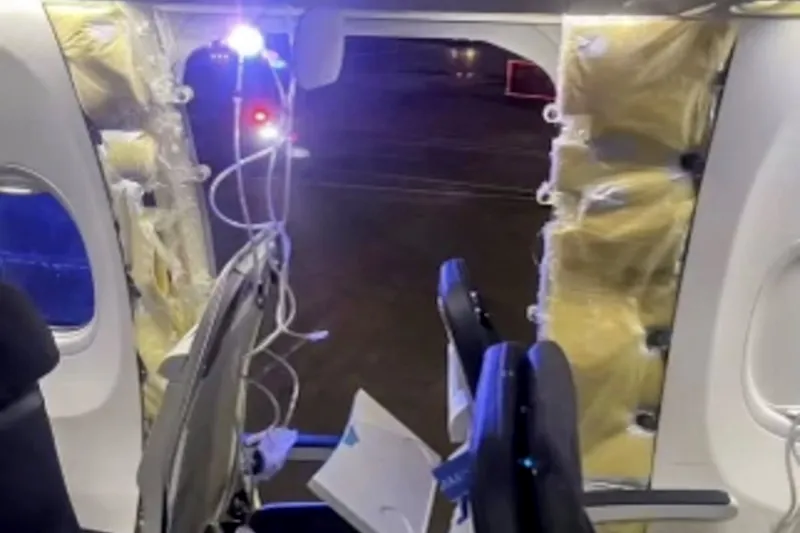


The Federal Aviation Administration (FAA) has ordered the temporary grounding and inspections of a number of Boeing Co. 737 Max 9 aircraft worldwide. This decision comes after a fuselage section on a brand-new Alaska Airlines jet blew out shortly after takeoff, leaving a significant hole. Alaska Airlines, the second-largest operator of the Max 9, had already grounded its fleet in response to the incident, and United Airlines, the largest operator of the model, has also taken some of the jets out of service for inspections.
In light of the incident involving Alaska Airlines Flight 1282, FAA Administrator Mike Whitaker emphasized that safety remains the top priority and will guide the decision-making process. The temporary grounding is the most significant response to an incident since the entire fleet of Boeing's Max aircraft was temporarily taken out of service in 2019 following two fatal crashes. The Max series is Boeing's most popular aircraft, generating a significant portion of the company's revenue.
The grounding affects approximately 171 Boeing 737 Max 9 aircraft worldwide. In the US, only two airlines operate the Max 9 variant: United Airlines with 79 aircraft and Alaska Airlines with 65. Alaska Airlines has already completed inspections on a portion of its fleet without uncovering any concerning findings and plans to return the jets to service once inspections are completed satisfactorily. United Airlines, on the other hand, has inspected 33 of its Max 9 jets as per FAA requirements and has canceled around 60 flights as a result.
Alaska Airlines Flight 1282, with 171 passengers and six crew members on board, was en route from Portland, Oregon, to Ontario, California when the crew reported a pressurization issue. Shortly after, the rear left part of the fuselage blew out, creating a gaping hole resembling a doorway. The aircraft promptly returned to Portland, having reached an altitude of about 16,000 feet. Images and videos shared on social media revealed that part of the cabin wall had also torn off, exposing insulation material. Despite the terrifying ordeal, there were no serious injuries reported.
Following this incident, the Civil Aviation Administration of China is convening an emergency meeting to discuss a potential response, including the grounding of the Boeing Max fleet in the country. It is worth noting that the aircraft variant involved in the Alaska Airlines incident is not currently operated by Chinese carriers. China, being the first country to ground the Max after the previous crashes, has yet to resume accepting 737 deliveries.
The National Transportation Safety Board (NTSB) and Boeing are both investigating the incident. Boeing has expressed its support for the FAA's decision and is closely cooperating with the regulator and customers. The European Union Aviation Safety Agency is also evaluating whether any additional measures need to be implemented. The FAA announcement mentioned that the inspections are focused on the Boeing 737 Max airplanes, specifically looking for a possible loose bolt in the rudder control system.
The Boeing 737 Max 9 has modular fuselage layouts that allow for flexible installation of emergency doors depending on the seating capacity. Boeing includes a cabin exit door located aft of the wings but before the rear exit door on the Max 9 to meet evacuation requirements in densely seated configurations. However, these doors are permanently sealed on Alaska Airlines aircraft without any activation required.
The temporary grounding of the Max 9 fleet is a significant setback for Boeing, which has already faced numerous manufacturing defects and costly repairs in recent years. The company has been working on resolving issues like misaligned drilling holes in the rear section of the 737 and addressing the possibility of a loose bolt in the rudder control system.
While this incident is concerning, the Alaska Airlines jet did not experience a powerful decompression like the Southwest Airlines plane in 2018, where an exploding engine shattered a window, causing a passenger to be partially sucked out and ultimately leading to her death. Passengers on the Alaska Airlines flight were seated near the hole but remained safe throughout the ordeal. Alaska Airlines operates an all-Boeing fleet.
Inspections of the affected aircraft are expected to be completed in the coming days, and Alaska Air Group CEO Ben Minicucci has assured customers that the airline is committed to safety and will work diligently to return the fleet to service once inspections are successfully concluded.