


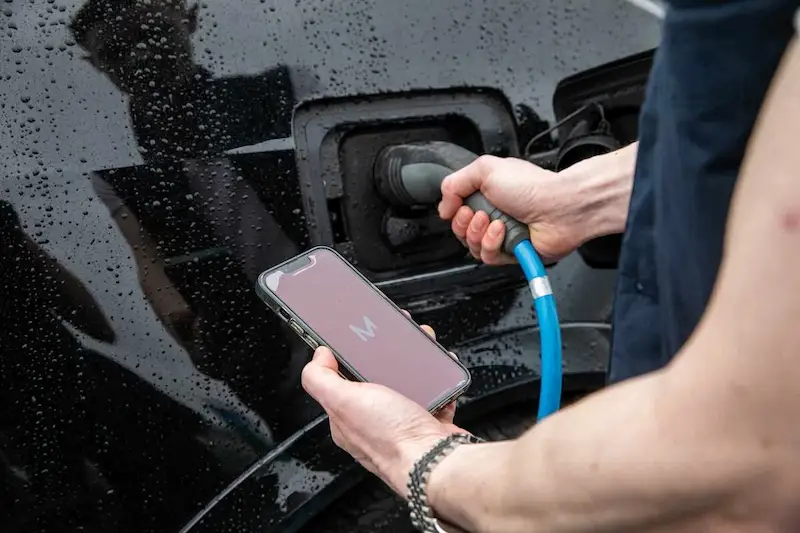


Danish startup Monta has successfully raised €80 million ($87 million) in venture capital to expand its electric vehicle (EV) charging management software business across Europe and the US. Despite the electric vehicle market experiencing a slower growth rate and limited public funding for charging infrastructure, investor enthusiasm for companies in the EV charging sector remains high.
Monta focuses exclusively on software, providing app and operational support to companies that operate charging stations for customers or employees. This approach requires less capital investment and allows Monta's system to integrate with most station equipment, according to CEO and co-founder Casper Rasmussen.
The competition in the EV charging market is fierce, with a multitude of software companies vying for a share of the ample public subsidies available for charging infrastructure, including the $7.5 billion allocated in the US. However, venture capital firm Energize Capital, which led Monta's investment round, believes that the company is in a prime position to emerge as a dominant player in this space.
Monta's strategic advantage lies in its positioning. EV charging has experienced significant growth in Europe, with more than 50,000 ultra-fast connectors added since 2020. The region also has double the number of EV fleets compared to the US. Monta boasts integration with over a third of the charge points in Denmark, its home country, and has expanded its operations to 20 countries. The UK is currently their biggest market in terms of sales. Monta recently partnered with German industrial giant Siemens and claims to have recorded a six-fold revenue increase in the previous year.
Expanding their growth across the Atlantic may pose a challenge for Monta. The number of new charging installations in the US fell short of BloombergNEF's expectations last year, creating uncertainty for companies like ChargePoint Holdings Inc., which offer both EV hardware and software solutions and have faced challenges competing with Tesla's extensive network.
However, according to BNEF analyst Ryan Fisher, increased competition could benefit software specialists like Monta. Fisher predicts that charging station operators will seek separate contracts with equipment manufacturers and software providers to gain stronger negotiating power.
Monta also sees potential in working closely with electricity grids. The startup has introduced a feature in a few countries that automatically suspends charging during periods of peak demand while offering discounted rates to customers who sign up for this program.
Ellen Trolle, a vice president for Norlys Energi, a Danish utility and customer of Monta, believes that a future where EV owners can regularly supply power back to the grid is rapidly approaching, and Monta is well-positioned as a software provider to facilitate this.
However, Monta will face challenges from Tesla's expansive charging network and competition from traditional oil and gas companies that are venturing into the EV charging space. Nonetheless, Rasmussen remains optimistic, stating that even if EV sales slow down in certain countries, there are always other nations picking up the pace and driving demand in the market.