


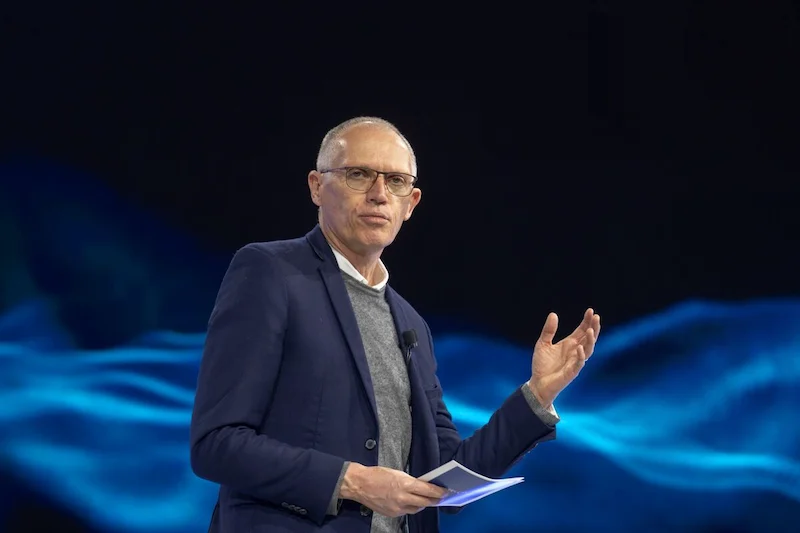


Stellantis NV's CEO, Carlos Tavares, has set his sights on Renault SA as he anticipates a wave of consolidation in the auto industry. Tavares believes that the race to produce more affordable electric vehicles will ultimately lead to a "bloodbath," and he sees Renault as a vulnerable player in this arena. While he cannot formally pursue Renault due to the French state's ownership and influence over the company, Tavares has been strategically positioning Stellantis to capitalize on any setbacks faced by Renault.
This week, Tavares got the stumbling block he had been waiting for when Renault announced the cancellation of its multiyear pursuit of an initial public offering (IPO) for its electric vehicle (EV) business, Ampere. In an exclusive interview, Tavares questioned Renault's strategy and whether the company will have the scale to compete with Stellantis, as well as EV leaders Tesla Inc. and BYD Co.
Renault, however, has reiterated that it has the ability to self-fund its future and has stronger cash generation, which factored into its decision to call off the IPO. Tavares has been publicly critical of the way Renault carved out its EV business and has dismissed suggestions that Stellantis isn't investing as much in France. He has even organized media events to coincide with or preempt Renault's already-scheduled briefings.
Tavares has been adamant about the need to protect his company's numbers in an industry that he believes is entering a Darwinian phase. As long as Stellantis remains financially robust, Tavares believes the company will be well-positioned for any kind of consolidation maneuvering. His counterpart at Renault, CEO Luca de Meo, has declared the company "back from hell" after surviving a challenging period exacerbated by the pandemic. Renault managed to stabilize with the help of a €5 billion loan backed by the French state.
De Meo has divided Renault into five business units, including the EV business Ampere and the combustion engine and hybrid vehicle company, Horse. However, Tavares is not interested in pursuing a similar strategy for Stellantis. He firmly believes in maintaining unity within the company rather than creating separate entities for various operations.
The intense interest in Renault from Tavares is personal, as he spent the majority of his career at the company before his dramatic departure in pursuit of then-CEO Carlos Ghosn's position. Tavares joined PSA Group, which later merged with Fiat Chrysler to form Stellantis. While Stellantis has been expanding its brand portfolio, including Peugeot, Citroën, Opel, and Jeep, Renault has scaled back its alliance with Nissan Motor Co.
In the past year, Renault and Nissan dissolved their joint-purchasing organization, which had been hailed as one of the more successful aspects of their relationship. Renault has also started divesting its stake in Nissan. Furthermore, Renault has been edging closer to Chinese partners, such as Zhejiang Geely Holding Group Co., with whom the company set up Horse, and Envision Group, which supplies Renault with EV batteries.
However, any pursuit of Renault by Stellantis would face significant obstacles. The French government has a vested interest in protecting jobs at both companies, given their significant presence in France and the government's shareholding and presence on their boards. Government intervention has played a role in the collapse of Renault's previous deal attempts, such as the proposed merger with Fiat Chrysler, which was blamed on political interference.
Additionally, Renault's CEO has been in discussions with Volkswagen and other automakers about potential collaborations to develop more affordable EVs. Tavares believes that such a partnership could render Renault reliant on Volkswagen, further complicating the company's prospects.
For now, Tavares is leveraging the rivalry between Stellantis and Renault both subtly and overtly. He has poached several top executives from Renault to join Stellantis, disrupting the company's internal management structure. The companies have even clashed over their event calendars, with both planning to release their full-year results on the same day.
Tavares is steadfast in his belief that Stellantis is in a different league than Renault and dismisses any suggestions that Renault is investing more in France. With his eye on the future of the auto industry and the impending consolidation, Tavares is positioning Stellantis to be one of the winners, ready to seize any opportunities that arise.