


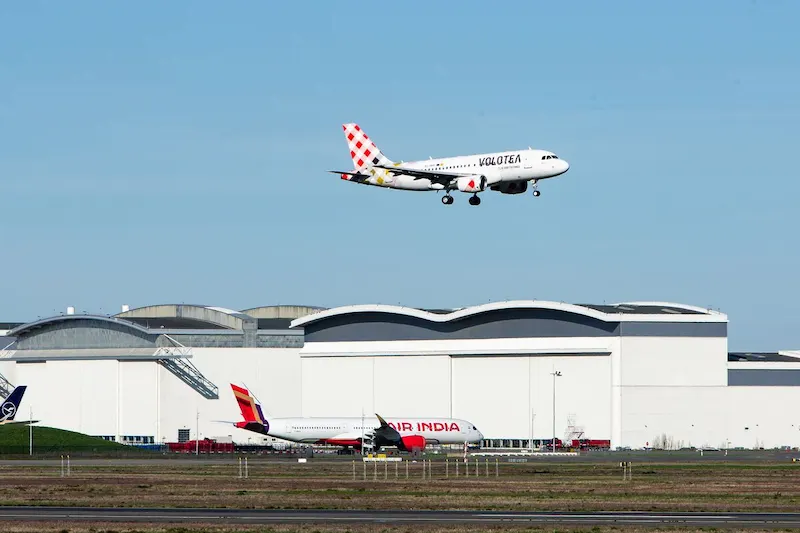


Airbus has announced plans to develop an all-new successor to its popular A320 family, aiming to replicate the success of the model that put the European manufacturer on the map over three decades ago. The new program seeks to overshadow Boeing's 737 and solidify Airbus's dominance in the single-aisle market. The company is currently engaged in two separate projects, one for a smaller hydrogen-powered aircraft capable of flying about 1,000 miles, and another for a short- to medium-range A320 successor that will run on sustainable aviation fuel.
CEO Guillaume Faury provided insights into the ongoing projects during Airbus's annual earnings conference in Toulouse. According to Faury, the company is currently in the testing phase of both projects. The hydrogen-powered aircraft, which will initially carry around 100 passengers, will serve as an experimental prototype before potentially scaling up. Airbus is actively evaluating different propulsion systems and expects to finalize details such as size and target market around 2025 or 2026. The official launch is anticipated in the 2027-28 timeframe.
In addition to the hydrogen-powered aircraft, Airbus is also focusing on developing an all-new platform to succeed the A320 series. This new aircraft is slated to enter service in the second half of the next decade. The seating capacities for these models range from approximately 140 to 240, depending on the specific subtype and configuration.
The importance of the single-aisle market cannot be overstated for both Airbus and Boeing, contributing substantially to their profits and overall market presence. In recent years, Airbus has gained an upper hand in this segment, partially due to Boeing's challenges with the 737 Max. Both companies have realized that simply modifying existing aircraft designs is not sufficient anymore, necessitating a more comprehensive approach.
Airbus's latest aircraft, the A350 widebody, boasts significant advancements in the use of carbon-fiber materials. Boeing's answer to this was the 787 Dreamliner, introduced in late 2011. However, these incremental improvements are no longer sustainable, prompting the need for an all-new design.
The design of the next-generation Airbus aircraft will heavily depend on the selected engine. One potential option is CFM International's RISE open rotor engine, which replaces the conventional ducted jet engine with large jet blades. Airbus is actively considering this architecture for the A320 successor.
While Airbus moves forward with its ambitious plans, Boeing has been focused on addressing its factory issues and reducing its debt. Last year, Boeing collaborated with NASA, US airlines, and other partners on a potential successor to the 737 Max. The competition between Airbus and Boeing in the single-aisle market promises to heat up as both manufacturers race to introduce cutting-edge aircraft technology and capture market share.