


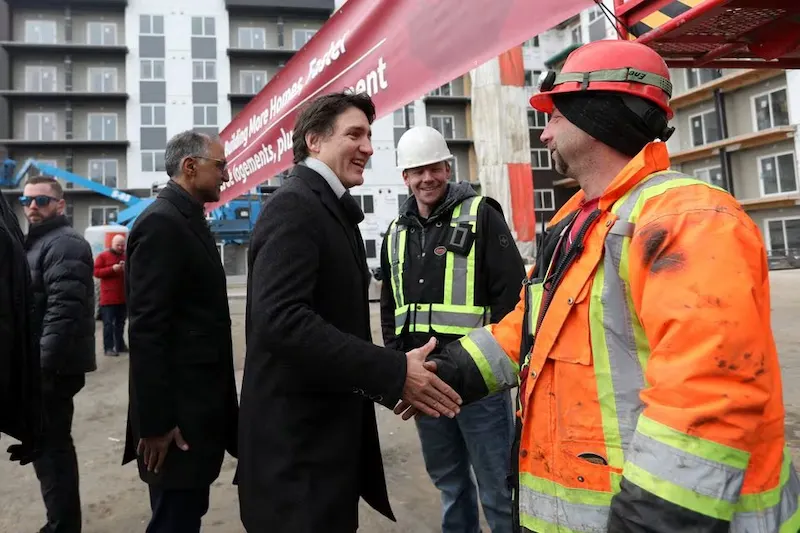


Canada's recent decision to extend the ban on foreign ownership in its property market for another two years may not have the desired impact on addressing the country's acute housing shortages, according to economists and real estate experts. The move, announced suddenly on a Sunday morning last month, has been met with skepticism, with some viewing it as a political maneuver to appease opposition pressure and demonstrate proactive action on the housing market by the government.
While housing affordability has become a pressing issue leading up to next year's election, with Conservative Party leader Pierre Poilievre holding the Liberal government accountable for the crisis, the ban extension seems to be more about political optics than real economic impact. Over the past year, the federal government has implemented several measures to increase housing supplies, but these initiatives are unlikely to offer immediate relief. The decision to extend the ban nearly a year before its expiry appears to coincide with a drop in Prime Minister Justin Trudeau's public support to its lowest levels in years.
Foreign ownership of residential properties in Canada has seen a significant decline, currently estimated to be as low as one percentage point from the 2-3% range seen two years ago. Even before the pandemic, Statistics Canada data showed that foreign ownership levels were consistently within the same range. While foreign buyers have been identified as drivers of soaring housing prices in other countries like Australia, the U.K., and New Zealand, Canada's ban on foreign ownership remains one of the strictest approaches globally.
The Finance Ministry has expressed concerns about foreign ownership exacerbating housing affordability issues and pricing out Canadian buyers. However, economists and real estate professionals argue that the fundamental solution lies in ramping up the construction of new housing units and sustaining this increased pace. Prime Minister Trudeau has acknowledged that the current housing crisis primarily stems from insufficient housing supply amidst a growing population, prompting recent adjustments to immigration policies.
Since Trudeau took office in 2015, Canada has welcomed 2.5 million new permanent residents, propelling the population to a record 40 million, while only 1.8 million homes were constructed during the same period. To meet the housing needs of the expanding population, Canada would need to build 315,000 new residences annually until 2030, a figure significantly higher than recent completion rates. Addressing the housing shortage necessitates a holistic strategy that emphasizes substantial increases in housing construction.
Realtors note that foreign buyers have typically targeted premium properties in urban centers such as Toronto, Vancouver, and Montreal, meaning that the ban extension is unlikely to directly benefit first-time homebuyers, who constitute a significant portion of the market. While house prices have dipped by 1.3% in the past eighteen months, this decrease is primarily attributed to the Bank of Canada's aggressive interest rate hikes rather than the foreign ownership ban.
Industry experts, including the Canadian Real Estate Association, have criticized the ban extension as unnecessary, citing a lack of empirical evidence linking foreign ownership to the housing crisis. Derek Holt, head of capital markets at Scotiabank, characterized the ban as a baseless and xenophobic measure that unfairly scapegoats foreign buyers who have had minimal impact on the market. In essence, the extension of the ban appears to be a superficial solution to a complex issue of housing supply and affordability in Canada.