


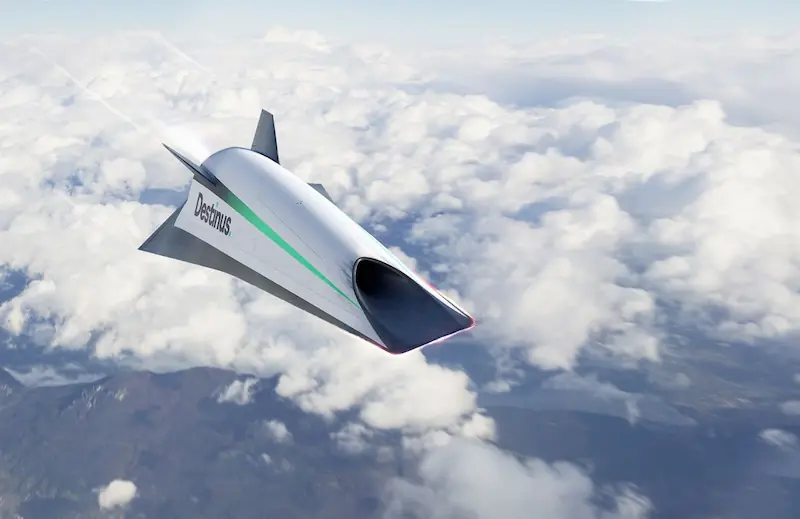


A Swiss-based startup called Destinus is entering the race to develop hypersonic planes, promising travel at five times the speed of sound and cutting flight times to less than a quarter of current commercial air travel.
Using hydrogen as a fuel source, the company hopes to create a zero-emissions aircraft capable of flying ultra-long ranges. Destinus' long-term goal is to operate a fully hydrogen-powered fleet by the 2040s, including both business and economy class.
Destinus has already achieved several significant milestones in the development of its hypersonic planes. The company's first two prototypes have already made successful test flights, with the third prototype set to launch by the end of the year. Destinus plans to develop smaller autonomous drones before scaling up to larger, pilot-driven or passenger-carrying aircraft.
While other hypersonic plane projects have stalled or run into delays, Destinus is taking a different approach. Rather than focusing on the development of mockups and piloted aircraft, the company is going directly to autonomous flights. This strategy allows them to develop smaller-size drones before scaling up to larger aircraft.
One of the key advantages of using hydrogen as a fuel source is that it is a clean, renewable energy source that is increasingly inexpensive to produce. Hydrogen-powered aviation is still in its infancy, with hydrogen jet engines yet to enter commercial use. However, Airbus is developing a hydrogen jet engine that it says will begin flight testing in 2026.
The Destinus prototypes are blended-body planes in the waverider shape - a hypersonic design first conceived in the 1950s but never reaching production - with the company's Swiss/French origins being reflected in paintwork inspired by the Alps. The waverider shape is a pretty efficient design that allows the aircraft to ride on top of the shock waves generated from the vehicle itself, using less fuel to fly through the air.
The upcoming prototype, Destinus 3, will be supersonic, and the company hopes to achieve supersonic hydrogen-powered flight in 2024. The vehicle is about the same size as the previous prototype, but it's ten times heavier and 20 times more complex in terms of the structure and propulsion system.
Destinus' short-term plan is to power takeoff with Jet A - conventional aviation fuel - and then switch to hydrogen when they hit speeds of around Mach 3. This is because hydrogen doesn't become useful or better than Jet A until the aircraft reaches supersonic speeds.
Destinus' plans are quite dependent on the vagaries of the hydrogen market, which the company admits it's not in control of. However, experts both inside and outside the company estimate hydrogen prices will drop significantly by the 2040s, allowing the company to reduce the prices of ultra-long-range flights.
While there may be technological, environmental, and financial hurdles to overcome, Destinus is hopeful that its realistic approach and additional revenue streams will help them succeed where other supersonic and hypersonic projects have failed. In addition to securing public funding, the company recently acquired Dutch company OPRA, now named Destinus Energy. This acquisition will allow them to generate revenue from gas turbines that are already being sold.