


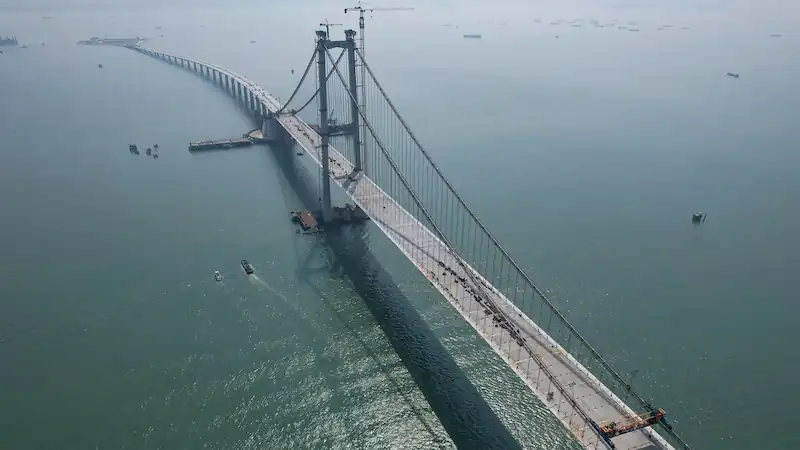


China has recently completed construction of the Shenzhen-Zhongshan Bridge, a new ambitious infrastructure project that stretches for 15 miles, has eight lanes, includes artificial islands and an undersea tunnel, and has a price tag of $6.7 billion. The bridge's builders have even claimed a world record for paving over 243,200 square feet of asphalt in a single day. However, this bridge is not the world's longest sea bridge, as this title belongs to the Hong Kong-Zhuhai-Macao Bridge, which is only 20 miles away.
Despite the scale of these infrastructure projects, China's ambitions are not only limited to massive constructions, but also extend to its desire to make the Greater Bay Area into an economic and technological hub that rivals major metropolitan areas such as San Francisco, New York, and Tokyo. The Greater Bay Area, which encompasses 11 cities, including Hong Kong, Macao, Shenzhen, and Zhongshan, is home to 68 million people and covers 21,800 square miles.
The Shenzhen-Zhongshan Bridge will be a crucial part of China's master plan to connect the cities in the Greater Bay Area physically and conceptually. With travel times expected to be reduced from two hours to 20 minutes between Zhongshan and the Shenzhen Bao'an International Airport, the bridge will drastically cut commutes and traffic. However, besides addressing the economic and practical needs of the region, the bridges also serve China's political interests by integrating formerly independent regions -- Hong Kong and Macao were once colonies of Britain and Portugal, respectively -- into a single Chinese identity.
Critics of China's massive infrastructure projects and the Belt and Road Initiative -- which involves Beijing's multibillion-dollar funding of infrastructure projects around the world -- accuse the country of using such developments to gain economic and political leverage. While there are no such debt concerns with the bridges, the scale of the construction project sends a message about China's global influence. However, the impact of the bridges will ultimately depend on how successful and popular the infrastructure proves to be with travelers. Some observers point out that the Hong Kong-Zhuhai-Macao Bridge still struggles to attract significant traffic due to the need for separate visas and vehicle registrations, despite its grandeur.
Additionally, the Greater Bay Area faces several significant challenges that have hampered development. The region has three borders that retain separate legal, immigration, and even currency systems. Residents carry three different passports and identity cards and speak two different forms of Chinese. These obstacles have made it difficult to connect the cities of the Greater Bay Area and can be seen in the lack of popularity that the Hong Kong-Zhuhai-Macao Bridge currently enjoys.
Despite these challenges, some experts believe that the Shenzhen-Zhongshan Bridge will help level up the region and reduce the discrepancy in property prices between the east and west coasts. Furthermore, as the two cities connected by the bridge already operate under the same regulations, travel between them should be seamless. The bridge's connection of the cities physically and conceptually contributes to China's development goals, although its ultimate success and economic impact are yet to be seen.