


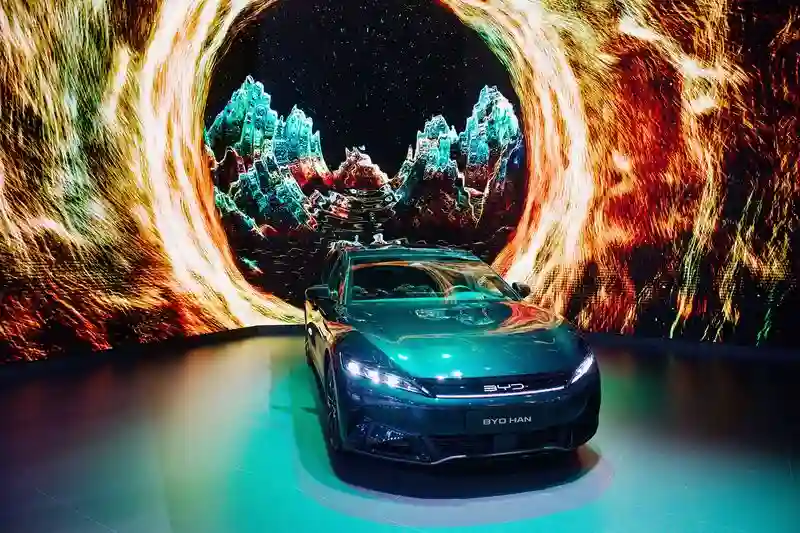


Chinese automaker BYD is quickly emerging as a major player in the global electric vehicle (EV) market. Although Tesla is often considered the dominant EV maker in many countries, BYD is the bestseller in emerging clean-car markets such as Brazil, Israel, and Thailand. These bragging rights reflect the company's growing global popularity, as its wheels are increasingly plying streets from Sydney to Delhi, and even Montevideo, Uruguay.
One reason for BYD's success is its vertical integration strategy, which allows management to control the costs of manufacturing more components in-house. Unlike competing automakers, BYD produces its own batteries (making it the world's second-largest cell maker) and semiconductors, which helps shield the company from supply chain issues. This approach has made BYD a notable disruptor in the Chinese market; it overtook Volkswagen AG as the nation's biggest-selling car brand during the first quarter of 2022. In that same quarter, BYD accounted for 39% of new-energy vehicle sales (electrics or hybrids) or 12% of all passenger-car sales in China.
In addition to its success in China, BYD is rapidly expanding internationally. The company recently entered Mexico, Spain, and the UK, and is launching in Italy this month. It is also selling EVs in 53 countries and regions around the world, making it the largest automaker that most people have never heard of. BYD's popularity stems from its range of good-looking, well-functioning cars at the right price. Its latest electric hatchback, the Seagull, part of the company's Ocean series, starts at just $10,400, with a 55-kilowatt motor and 30-kilowatt-hour battery that provide around 300 kilometers (190 miles) on a charge and a top speed of 80 miles per hour.
BYD's success in the EV market is evidenced by the fact that it sold 1.86 million new-energy vehicles last year, more than in the previous four years combined. Its global workforce doubled to 570,060, which is about 200,000 more than the roster at the world’s No. 1 automaker, Toyota. Although BYD derives over 75% of its revenue from China, it's gaining ground against Tesla on an EV-only basis. BloombergNEF data shows that BYD has become the leading clean-car maker in countries such as Brazil, Colombia, Israel, and Thailand, outpacing BMW AG and Renault SA along with fellow Chinese automakers Zhejiang Geely Holding Group Co. and Hozon New Energy Automobile Co.
BYD's affordability is one of its biggest selling points, which CEO and founder Wang Chuanfu attributes to vertical integration and cost control. The company's entry-level EVs are priced below $10,000, while higher-end models such as the Han start at about $32,800, and the recently released Yangwang U8 SUV has a presale price of approximately $154,000. However, even at the high end, BYD's cars are still less expensive than Tesla's.
BYD's success has won over many drivers around the world, from Australia and New Zealand to Uruguay. Michael Barnden, a retired teacher in Adelaide, Australia, bought a BYD Atto 3 electric SUV last November and finds it welcoming to drive. Meanwhile, in New Zealand, the Atto 3 won the Motoring Writers' Guild's Car of the Year award in 2022, beating Tesla's Model Y and other competitors.
BYD's international ascent is missing one key market, however: the United States. Although BYD sells electric buses in the US, it has no plans to enter the passenger-car market, where President Joe Biden's Inflation Reduction Act offers tax credits of up to $7,500 toward consumer purchases of EVs—but only if the cars are manufactured in North America. Stella Li, executive vice president and head of BYD's North American operations, says the company doesn't need to go into every market but is focusing on ones where it feels its offerings are ready to compete.